April 2023
What is the water quality in Uganda?
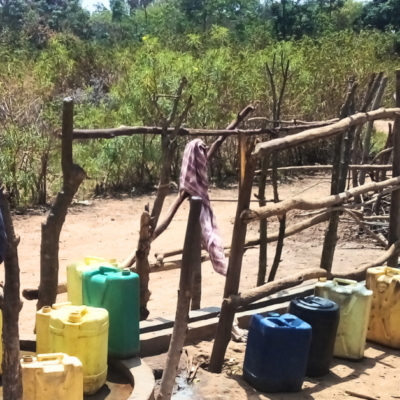
Collaborating with Stanford University and International Growth Research & Evaluation Center (IGREC), The Aquaya Institute has coordinated longitudinal water quality monitoring in two target districts in Uganda. In April – May 2022, we conducted surveys and water quality testing at households, water points, Schools and healthcare facilities in Lira and Kabarole Districts.Hilwa
Survey locations
Water Testing

Kabarole District
Kabarole District is a district in Western Uganda. It is part of the Kingdom of Toro. Its main town was Fort Portal before 1st July 2020, when it was elevated to a city, separating it from Kabarole district Government. This was one of the focal districts in Uganda where we conducted water quality tests and surveys. Watertracs
Water Points
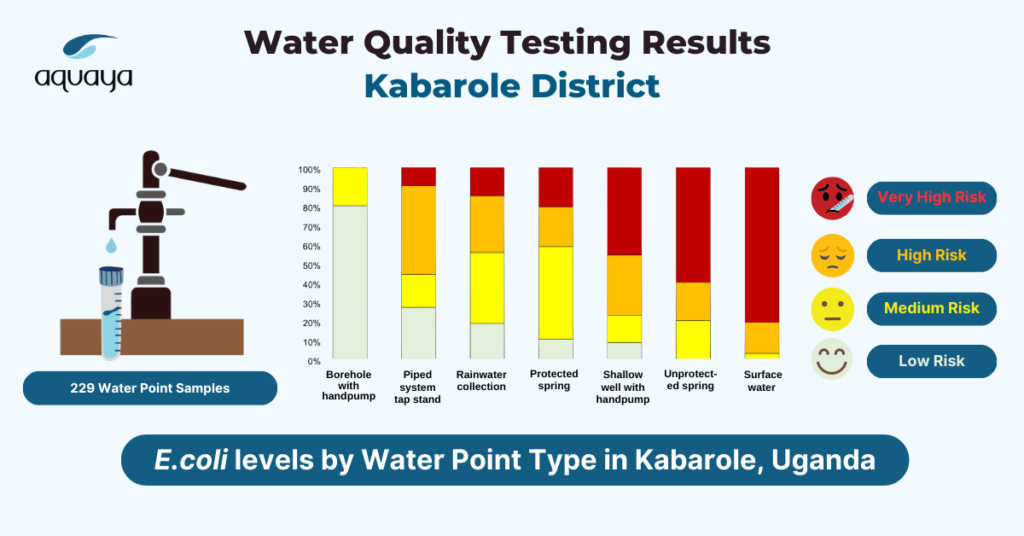
We conducted surveys and tested E. coli at 229 water points, including improved and unimproved types. Only 13% of water point samples were free from E. coli contamination, and E. coli was present across all source types. Water was slightly safer from piped system taps stands, rainwater collection, and boreholes with hand pumps (27% free from E. coli) and less safe from springs, surface water, and dug wells (4% free from E. coli).

Household Samples
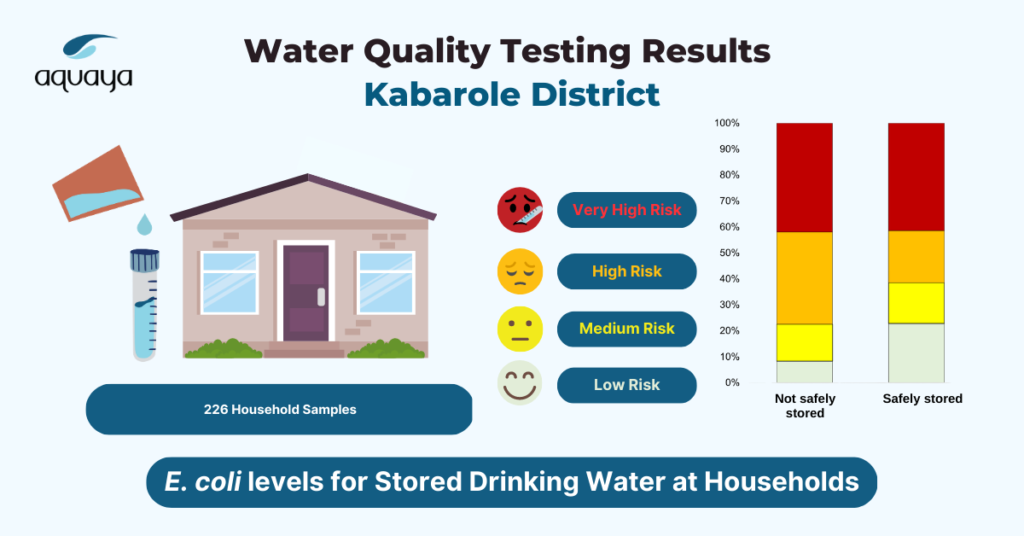
Overall, 13% of stored household samples had undetectable E. coli. Despite measured differences at water points, household contamination levels were consistent across all reported source types except for surface water and unprotected springs, which had lower quality.
Lira District
Lira is approximately 100 kilometers (62 mi), by road southeast of Gulu, the largest city in the Northern Region of Uganda, along the highway between Gulu and Mbale. This is approximately 124 kilometers (77 mi) northwest of Soroti, the nearest city to the south.
Water Points
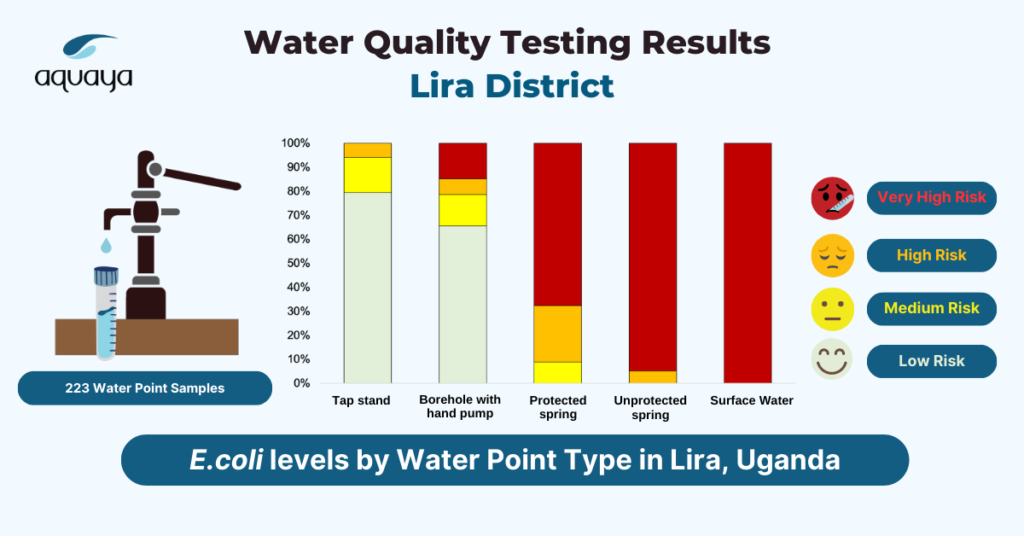
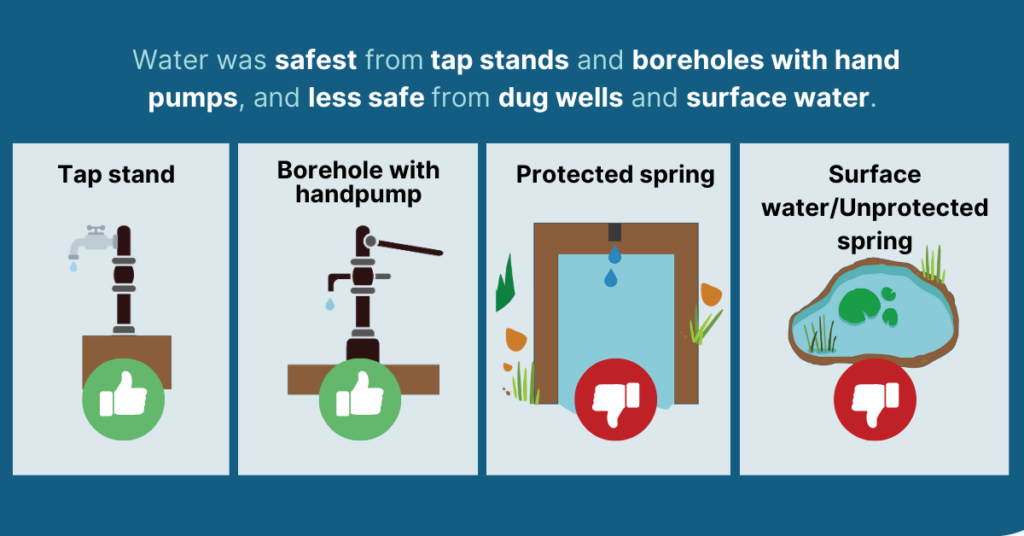
We conducted surveys and tested E. coli at 223 water points, including improved and unimproved types. About half of the water points (48%) were free from E. coli contamination. Water was microbially safest from piped systems and boreholes with hand pumps (79% and 66% free from E. coli, respectively) and less safe from unprotected springs and surface water (0% free from E. coli).
Household Samples
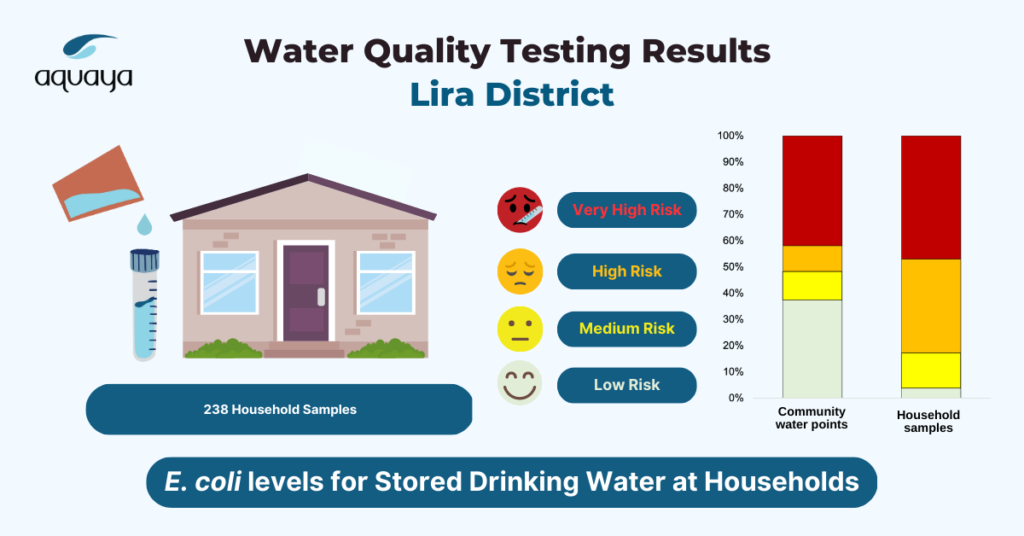
Household-stored water had higher concentrations of E. coli than samples collected from water points. We detected E. coli in 96% of household stored water samples, compared to 63% of samples taken directly from water points. There was no significant association between E. coli concentration and safe storage or household treatment habits, though both were reported in a small portion of households.
This work is supported by funding from the Conrad N. Hilton Foundation.