May 2024
What is the Water Quality in the Asutifi North District in Ghana?
Surveyed September 2023
Asutifi North District is one of the six districts in Ahafo Region, Ghana. Originally a single district formed in 1988, Asutifi was divided in 2012 with the south becoming Asutifi South District. The remaining northern part is the Asutifi North District.
The Aquaya Institute is coordinating longitudinal water quality monitoring in two target districts in Ghana (WaterTRACS). In September 2023, Aquaya conducted surveys and water quality testing at households, water points, schools, and healthcare facilities in Asutifi North District. This effort builds upon prior monitoring.
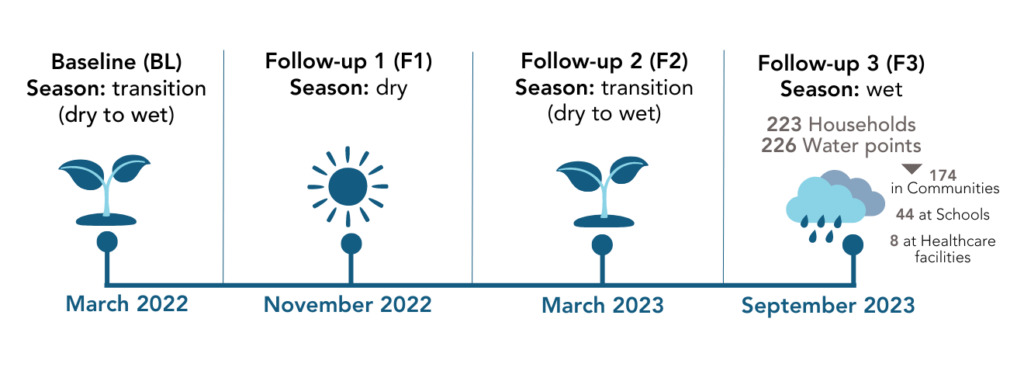
Timeline of drinking water samples tested in Asutifi North
Water points
In the most recent survey, we conducted surveys and tested E. coli at 226 water points. Overall, 39% were free from E. coli, defined as <1 CFU/100 mL. Water was consistently safe from piped systems and boreholes with hand pumps (57% free from E. coli) and less safe from dug wells and surface water (3% free from E. coli). Across all survey rounds, piped systems and mechanized boreholes were microbially safest in the dry season. In the most recent survey, only 4% of taps from piped systems met the Ghana National Drinking Water Standard for free chlorine residual (0.2-5.0 mg/L). Free chlorine residual protects water from recontamination during transport and storage. Chlorination levels were highest during the dry season (F1) when 15% of piped system samples met the standard. This coincides with the lowest E. coli counts.
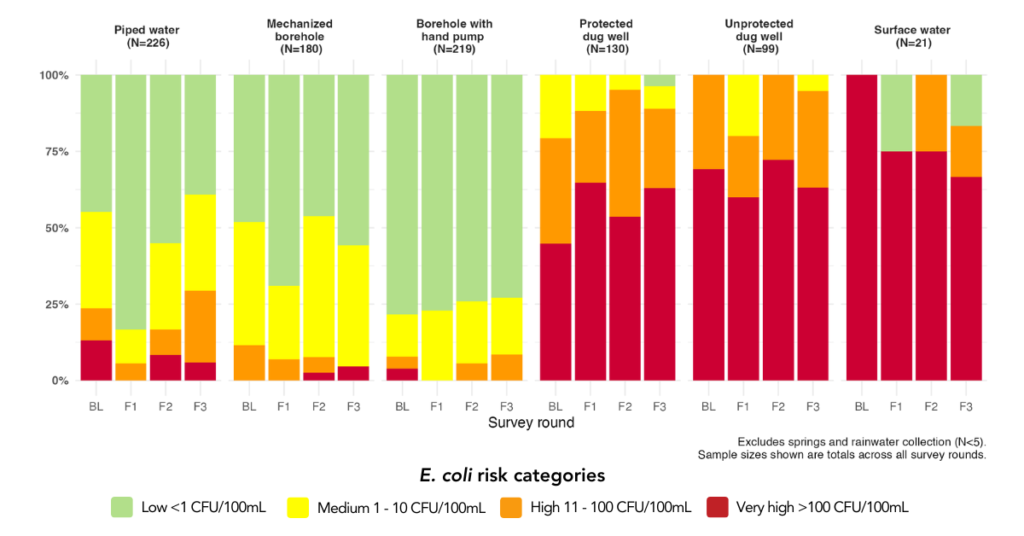
E. coli risk levels from water point samples collected at BL (N=204), F1 (N=114), F2 (N=219), and F3 (N=226) survey rounds.
Households
In the most recent survey, 32% of households provided packaged water (sachet or bottled) as a drinking water sample, 65% provided water from improved water points like piped systems and boreholes, and 3% provided water from unimproved water points like unprotected wells. Overall, 25% of the 223 household water samples were free from E. coli, and microbial water quality depended on the source of water.
Packaged water was safer than other household water sources. About 92% of packaged water samples – mostly sachet samples – were free from E. coli, but only 3% of samples from improved water points and none from unimproved water points were free from E. coli.
Institutions
In the most recent survey, we tested E. coli from water points at 44 schools and healthcare facilities. All schools and healthcare facilities used improved water points, and 85% had basic water service (an improved water point on premises with water available). The types of primary drinking water points used by healthcare facilities have started to shift from piped water and mechanized boreholes to packaged water.
Summary
- Water samples from improved sources were safer than those from unimproved sources.
- Very few piped water samples had adequate chlorine levels.
- Wealthier households had safer drinking water and were more likely to consume sachet water.
This work (WaterTRACS) is supported by funding from the Conrad N. Hilton Foundation.


