May 2023
What is the water quality in Ghana?
With funding from the Conrad N. Hilton Foundation, the Aquaya Institute has been coordinating longitudinal water quality monitoring in two target districts in Ghana. In March – April 2022, Aquaya conducted surveys and water quality testing at households, water points, schools, and healthcare facilities in Asutifi North and Wassa East district in collaboration with Stanford University and Kwame Nkrumah University of Science and Technology (KNUST). Hilwa
Survey locations
Water Testing

Asutifi North
Asutifi North District is one of the six districts in Ahafo Region, Ghana. The District was formerly part of the then-larger Asutifi District since 1988, until the southern part of the district was split off to create Asutifi South District on 28 June 2012. The remaining northern part is Asutifi North District.
Water Points
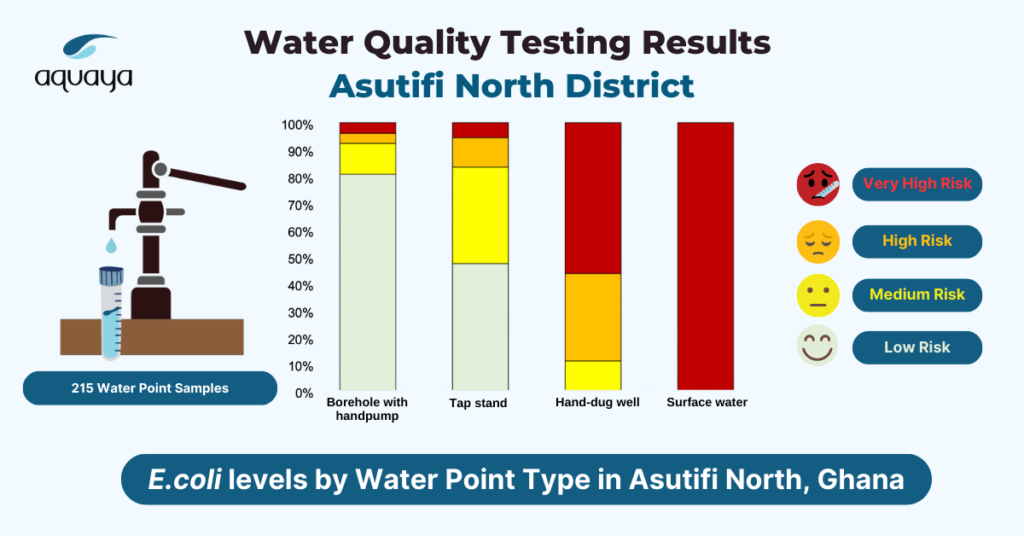
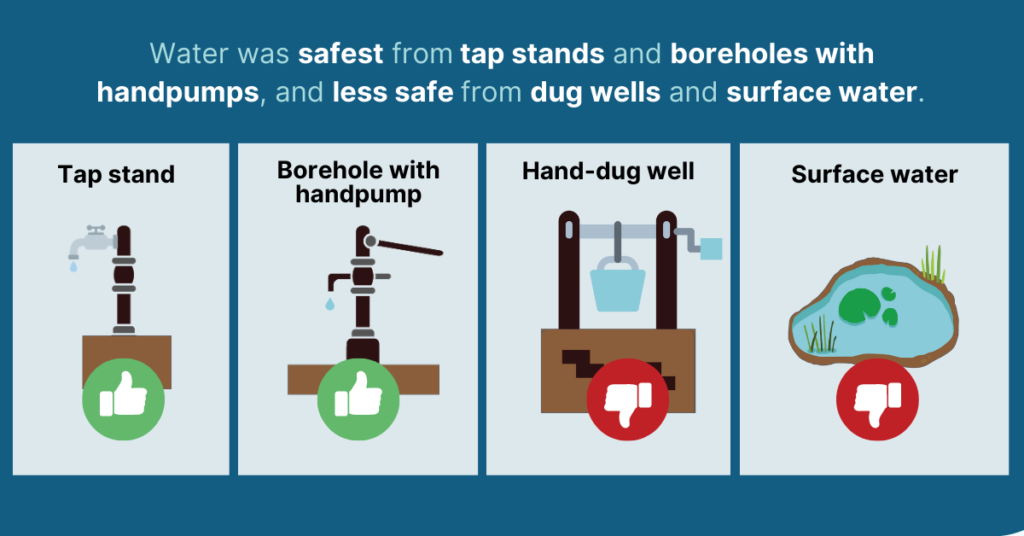
We conducted surveys and tested E. coli at 206 water points, including improved and unimproved types. Less than half of the water points (41%) were free from E. coli contamination. Water was microbially safest from piped systems and boreholes with hand pumps (59% free from E. coli) and less safe from dug wells and surface water (0% free from E. coli).
Household Samples
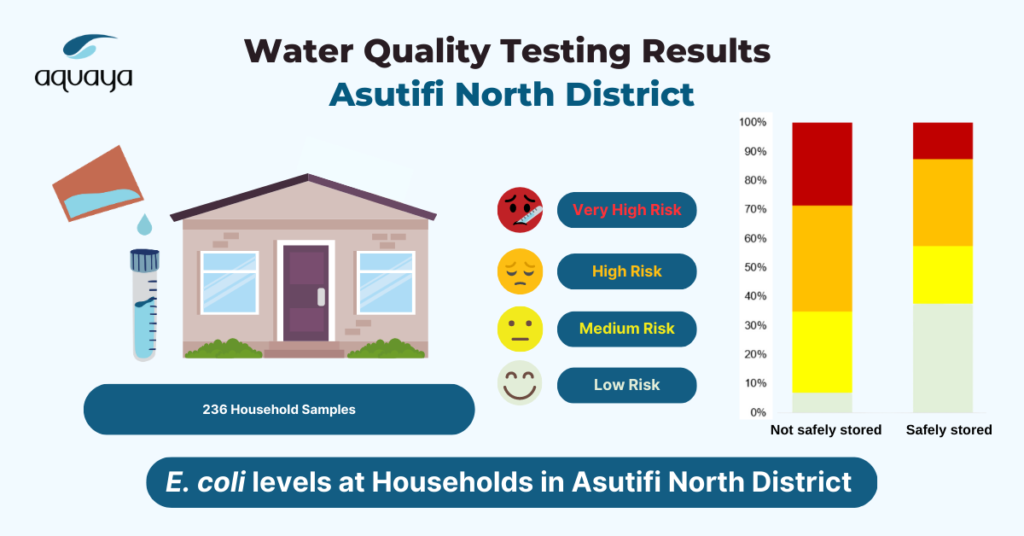
Household drinking water had higher concentrations of E. coli than samples collected directly from water points. We detected E. coli in 87% of household stored water samples, compared to 59% of samples taken directly from water points. This is due to contamination during transport, storage, and handling.
Wassa East
Wassa East District is one of the fourteen districts in the Western Region, Ghana. Originally it was formerly part of the then-larger Mpohor/Wassa East District in 1988, which was created from the former Wassa-Fiase-Mpohor District Council, until the southwest part of the district was split off to create Mpohor District on 28 June 2012; thus the remaining part has been renamed as Wassa East District. The district assembly is located in the eastern part of Western Region and has Daboase as its capital town.
Water Points
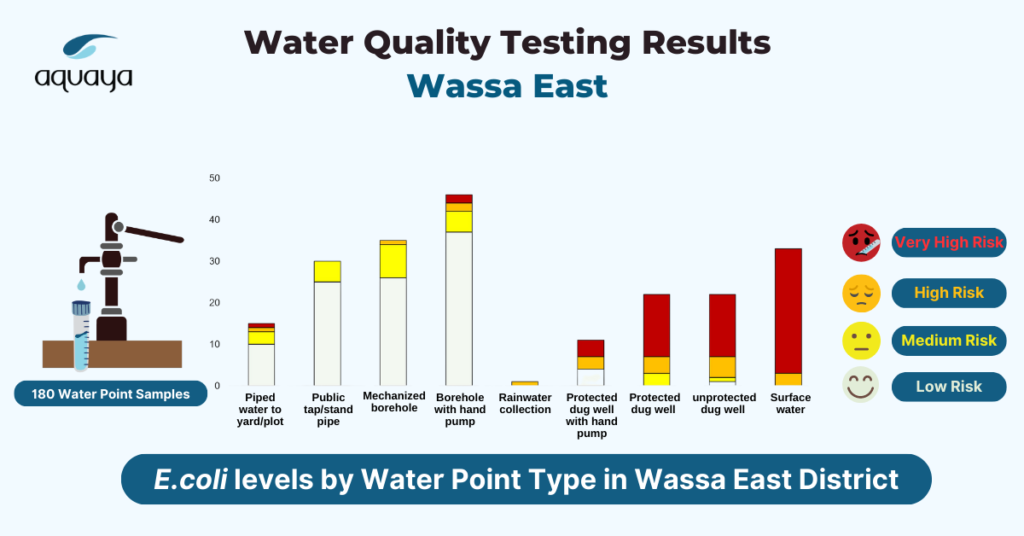
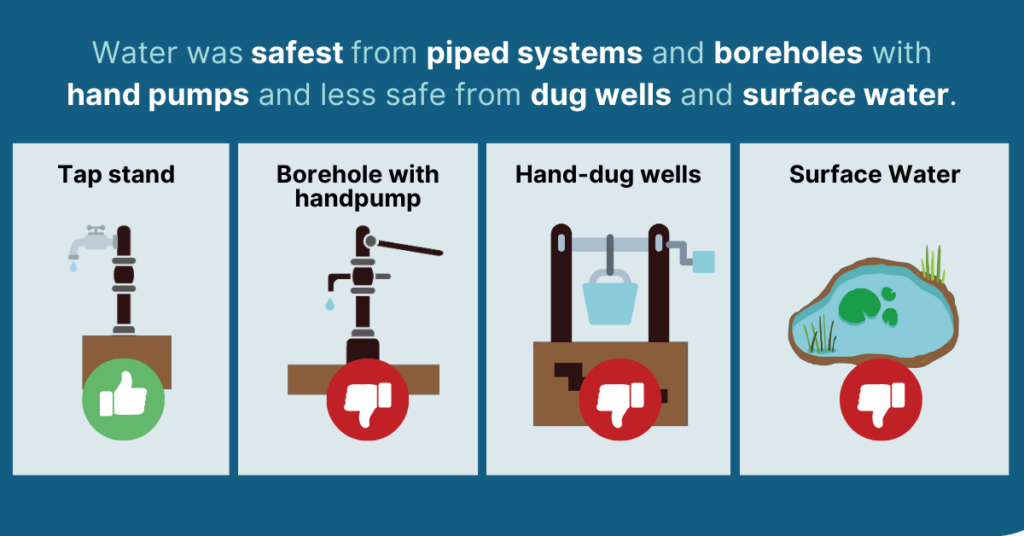
We conducted surveys at 230 water points and tested E. coli from 215 water points, including improved and unimproved types. About half of water points (48%) were free from E. coli contamination. Water was microbially safest from piped systems and boreholes with hand pumps (77% free from E. coli), and less safe from dug wells and surface water (6% free from E. coli).
Household Samples

Household drinking water had higher concentrations of E. coli than samples collected directly from water points. We detected E. coli in 80% of household stored water samples, compared to 52% of samples taken directly from water points. This is due to contamination during transport, storage, and handling.
This work is supported by funding from the Conrad N. Hilton Foundation and is part of the WaterTRACS Program.