November 2023
What is the Impact of the Water Quality Assurance Funds in Ghana?
The Water Quality Assurance Fund is a risk-mitigation product that allows established laboratories to extend water quality testing services to small rural systems fee-for-service. In cases where the water systems do not pay their testing bills, the laboratory can claim reimbursement from the Assurance Fund.
Small rural water systems often lack the resources and expertise to monitor water quality effectively. That’s where the REAL-Water Assurance Fund comes in.
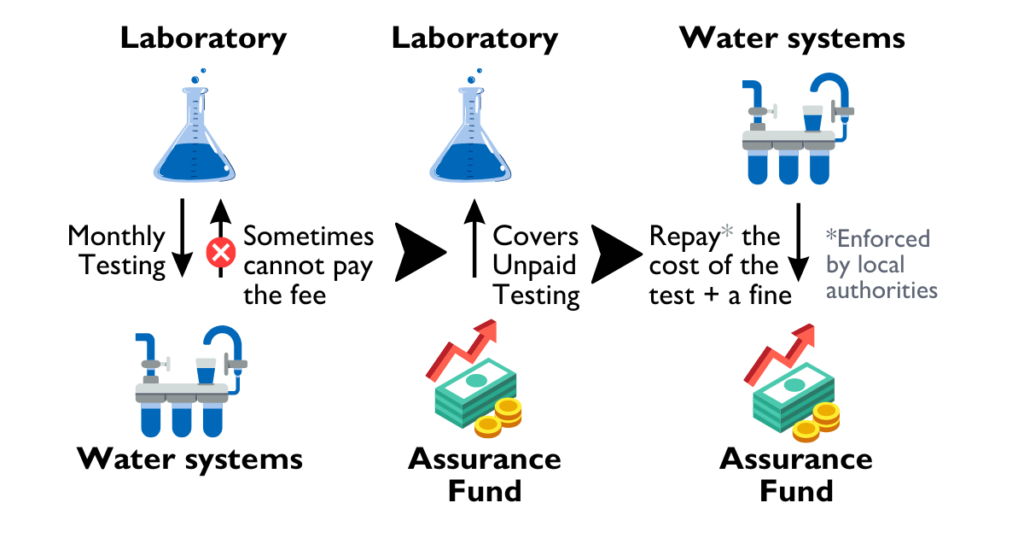
How it works: The Water Quality Assurance Fund implementation model. The model guarantees payment to laboratories for water quality testing services to rural water systems.
This report, developed by USAID/REAL-Water, summarizes baseline data collected before the launch of a two-year impact evaluation of the Water Quality Assurance Fund implementation model. This evaluation includes a randomized stepped-wedge trial, allowing rigorous impact measurements and gradual intervention rollout. The evaluation involves 28 water systems in rural Ghana —21 randomly assigned to one of three groups successively entering the program at six-month intervals and seven non-randomly assigned to the first group.
Summary of Baseline Findings
- Water systems were not adequately chlorinated.
- Water often had microbial contamination at the point of collection and almost always at the point of use.
- Water operators and local government officials generally had low knowledge of water quality.
- Most households were at least somewhat satisfied with the water, but many were willing to pay more for regularly treated and tested water.
- Water system communication with consumers could be improved.
- District Assemblies thought water quality was important but faced challenges in improving it.
- Some baseline imbalances exist between study arms that must be accounted for in future analysis.
DISCLAIMER: This brief is made possible by the support of the American people through the United States Agency for International Development (USAID). The contents of this brief are the sole responsibility of The Aquaya Institute and REAL-Water consortium members. They do not necessarily reflect the views of USAID or the United States Government.