February 2025
What Chemicals are in the Drinking Water of Wassa East District, Ghana?
Surveyed June 2024
Background
Globally, microbial drinking water quality remains a top health concern in low- and middle-income countries. There are also health risks associated with chemicals like fluoride, arsenic, and nitrates, which may be present in drinking water. Further, growing evidence indicates widespread lead contamination in drinking water supplies, often introduced through lead-containing water system components. Mining operations in southwestern Ghana, including Wassa East District, have also significantly contributed to environmental and drinking water contamination.
The Aquaya Institute is monitoring microbial water quality over time in two districts in Ghana (see prior research briefs). In June 2024, Aquaya also tested chemical water parameters at a subset of the district’s water points. The purpose of this analysis was to get a more comprehensive picture of water quality, including contaminants with known health risks, as well as physicochemical parameters affecting user acceptability.
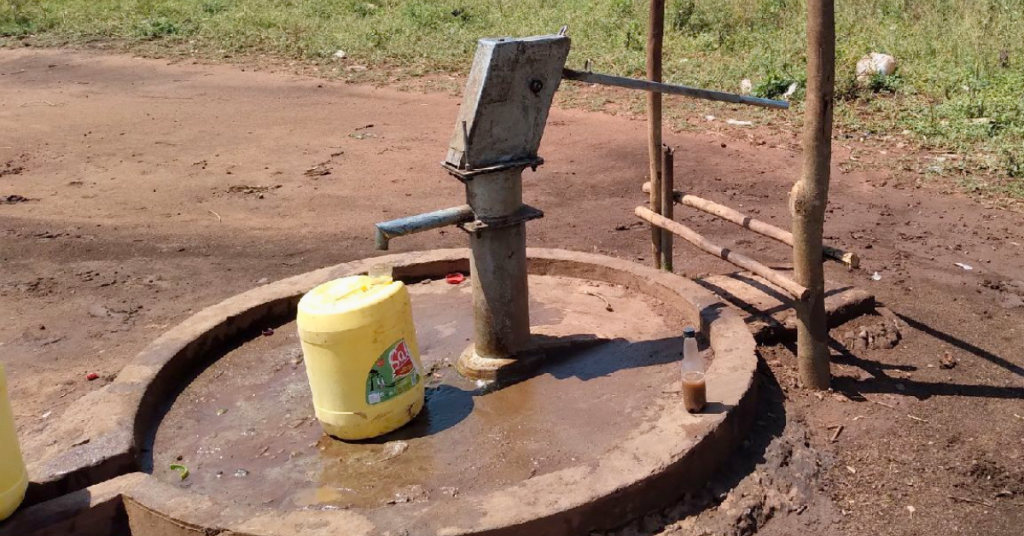
A handpump with a yellow container placed nearby in Wassa East
Results
Parameters with low health implications
Over half of samples (54%) had pH below the Ghana drinking water standard minimum value of 6.5, which may cause corrosion of metal parts in the water system. One-fifth (19%) of samples had turbidity above the standard of 5 NTU, which may reduce chlorine treatment effectiveness and may be visually unpleasant to water consumers. One-quarter (23%) of samples had iron levels above the standard of 0.3 mg/L. Elevated iron does not represent a known health risk, but water consumers may not like the water’s taste or appearance. All samples had electrical conductivity within the standard range.
Parameters with high health implications
We analyzed a set of chemicals (cyanide, fluoride, TON) and heavy metals (arsenic, cadmium, lead, mercury) that have known negative health impacts. Several of these may be introduced by gold mining activities in Wassa East District, including cyanide, arsenic, cadmium, lead, and mercury. Fluoride and arsenic were included due to their recognition as priority chemicals by the international WHO/UNICEF Joint Monitoring Programme, and nitrogen was included due to its persistence in rural areas.
All samples met the Ghana drinking water standard for cyanide, fluoride, TON, arsenic, cadmium, and mercury. This implies that gold mining operations have not negatively impacted drinking water supplies at the institutions included in our sample.
Overall, 11% of samples had lead levels above the Ghana standard of 10 parts per billion (ppb). Because of its health impacts, we include more information about lead in the following section.
Spotlight: Lead in drinking water (heavy metals in water Wassa East)
In some cases, lead is present in drinking water from naturally-occurring sources. However, in most cases, lead contamination in drinking water comes from lead-containing components in water systems, such as pipes, faucets, and plumbing fixtures. Exposure to lead in drinking water may lead to negative neurodevelopment effects, with infants and children being most vulnerable.
There is no safe level of lead in drinking water. In this brief, we report detectable lead as above 5 ppb due to the reporting limit of the analytical method used (ICP-MS, USEPA Method 200.8). We also report lead values above 0.01 mg/L (10 ppb), which is the maximum level allowed by the Ghana Standards Authority and is the WHO provisional guideline value for lead in drinking water.
One-quarter (26%) of drinking water samples had detectable lead (>5 ppb), and 11% exceeded the Ghana drinking water standard limit of 10 ppb, including one-tenth (8%) of school samples and one-fifth (21%) of healthcare facility samples.

Lead concentrations by water point type (note: the borehole with handpump category includes one dug well with handpump). One rainwater sample and one unprotected dug well sample were omitted from the graph.
Summary
- We tested water quality parameters at 71 water points from schools and healthcare facilities.
- Some water points exceeded drinking water standards for parameters with low health implications like pH, turbidity, and iron. These do not directly affect health but may be unpleasant to users and can interfere with treatment efforts.
- All samples met drinking water standards for arsenic, cadmium, and cyanide, indicating no measurable negative impacts from mining activities. Fluoride and nitrogen were also within safe limits.
- Lead levels exceeded drinking water standards in one-tenth of water points, which may have severe health implications.
This work (WaterTRACS) is supported by funding from the Conrad N. Hilton Foundation.