November 2025
Improving Water Quality Management, Water Equity, and Non-Revenue Water in Ghana
In 2023, the USAID URBAN WASH project launched a strategic partnership with Ghana Water Limited (GWL) to address critical challenges facing urban water service delivery. The Ghana buy-in inception report outlined an ambitious roadmap to strengthen three interconnected areas: water quality management, water equity, and non-revenue water reduction. Phase 1 of this partnership produced three technical reports and briefs, one for each component, summarized below.

Water Quality Management
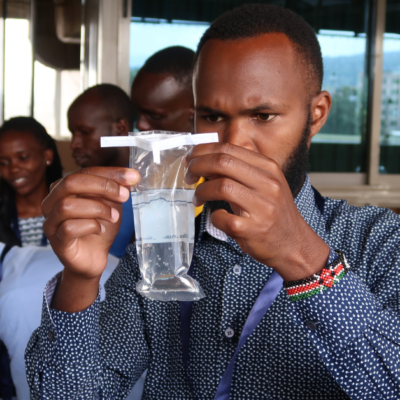
Approximately 40% of Ghana’s urban population lacks access to safely managed water. USAID’s URBAN WASH partnered with Ghana Water Limited (GWL) to evaluate water quality in Tamale and Kumasi. The study involved plant and lab visits, data analysis, household surveys, and testing for E. coli and chlorine. Findings showed low chlorine at the point of use, issues with turbidity, power outages, old pipes, and water rationing affecting quality. While GWL monitors water quality well, better use of data, equipment upgrades, process improvements, and staff training are needed to fully implement water safety measures.
WHY THIS MATTERS
In 2022, 1.7 billion people used contaminated water globally. Nearly 40% of urban Ghanaians lack access to safe water, and 39% of water points are contaminated with E. coli. Better water quality management can improve public health, environmental outcomes, and GWL’s finances, but WHO water safety planning adoption remains slow.
This study aims to support evidence-based decisions by GWL, USAID, and others to ensure safe urban water supplies.
This work was carried out by Aquaya, under the leadership of Tetra Tech

Water Equity and Tariffs
Wealth disparities worsen household water security and health inequities. The USAID URBAN WASH project collaborated with Ghana Water Limited (GWL) to study water service equity and financial sustainability in Tamale and Kumasi. Findings revealed that connection fees of 1,500–2,000 Ghanaian cedis/m³ and a residential tariff of GHS8.36/m³ were unaffordable for many, with 26% of households in Kumasi and 85% in Tamale unable to pay. Low-income families often rely on shared water connections that do not meet their basic needs. GWL struggles to recover costs solely through tariffs and must pursue efficiency improvements and additional funding. The study presents recommendations for improving water service equity through tariffs, strategic planning, and policy advocacy.
WHY THIS MATTERS
Sustainable city-wide water supply can reduce wealth inequalities. In Ghana’s cities, 40% lack safe water access, forcing low-income residents to rely on potentially unsafe sources. Many in peri-urban and low-income areas have limited formal services. GWL’s 2015 Low-Income Customer Support Department and block tariff subsidies help, but challenges remain in assessing residents’ wealth and applying higher rates appropriately.
This study examines how water pricing, affordability, and utility finances influence equitable access to safe, affordable water.
This work was carried out by Aquaya and SEGURA Consulting, under the leadership of Tetra Tech

Non-Revenue Water
As Ghana Water Limited (GWL) pursues financial sustainability, high non-revenue water levels present both a challenge and an opportunity. The USAID URBAN WASH project partnered with GWL to understand non-revenue water reduction barriers in Kumasi and Tamale and assess prepaid metering viability.
The study found that inadequate bulk metering, limited smart meter use, and insufficient leak detection resources undermine reliable on-revenue water estimates. Despite strategic plans, both cities struggle with sustainable reductions due to financial constraints affecting infrastructure, equipment, and staffing.
Key recommendations include prioritizing bulk metering at critical assets and district offtakes to improve measurement accuracy.
On prepaid metering, a tool for improving collections and customer visibility, the study found limited urban adoption in Ghana. While successful rurally, both GWL and customers showed limited interest, indicating more evidence is needed to justify urban implementation.
WHY THIS MATTERS
High non-revenue water challenges urban utilities in developing countries. Non-revenue water, produced but lost or unaccounted for, includes physical losses (leaks, bursts) and commercial losses (meter errors, theft), plus unbilled authorized use like firefighting. These losses severely impact finances, limiting GWL’s infrastructure investment capacity and eroding customer confidence. Utilities must reliably measure non-revenue water and identify root causes. Reduction requires understanding priorities, establishing baselines, and targeting solutions.
This study helps GWL prioritize non-revenue water reduction efforts effectively.
This work was carried out by SEGURA Consulting, under the leadership of Tetra Tech
URBAN WASH (Advancing Urban Water Supply, Sanitation, and Hygiene Resilience Worldwide) was a USAID-funded applied research and technical assistance program led by Tetra Tech. The project focused on improving sustainable, resilient, and equitable WASH services in urban, peri-urban, and informal settlements in low- and middle-income countries. Designed and originally executed as a five-year program, URBAN WASH was terminated in February 2025 along with the vast majority of USAID’s overseas development assistance programs.