September 2023
Uganda Institutional Framework for Water Supply
Aquaya’s new report, “Uganda’s Institutional Framework for Water Supply,” explores how the current water supply functions, where gaps exist, and what changes could strengthen service delivery in Uganda.
Country Overview
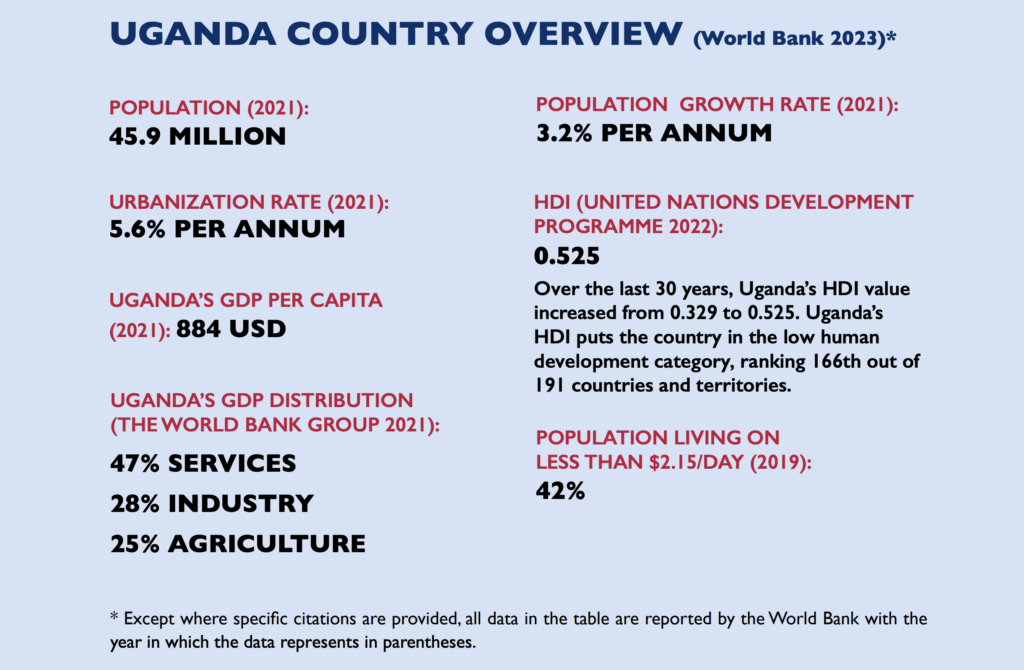
Uganda is a young, fast-growing, and rapidly urbanizing country: 45 percent of the population is under 15 (United Nations Population Division 2022), the urbanization rate is 5.6 percent per annum, and the gross domestic product (GDP) per capita in 2021 was $884 (World Bank 2023). The country’s Human Development Index (HDI) is 0.525, ranking 166th among 191 countries (United Nations Development Programme 2022).
Uganda has a parliamentary system with universal suffrage. The Local Governments Act of 1997 decentralized country governance, devolving specific powers, functions, and funds to local governments. With guidance from technical officers, local councils empower local governments to provide water services.
The 1995 Constitution defines clean and safe water as a fundamental right for all Ugandans. It divides responsibilities for water service provision between the national government and the 146 district local governments. According to the World Health Organization/United Nations Children’s Fund’s (WHO/UNICEF) Joint Monitoring Program (2020), Uganda’s water supply has improved substantially over the past 20 years: in 2020, 83 percent of Ugandan households accessed either piped water or improved groundwater, compared to 61 percent in 2000. However, according to Uganda’s Ministry of Water and Environment, household water access has remained between 65-69 percent since 2010 (Ministry of Water and Environment 2023).
Domestic/municipal and agricultural uses exert the most demand on Uganda’s abundant surface water while drinking water utilizes groundwater primarily. Annual surface water and groundwater abstraction rates will likely remain well below levels that would threaten sustainable utilization thresholds. However, climate change, increased frequency of extreme weather events, and the fast-growing urban population could exacerbate challenges of water resources and water infrastructure management.
Institutional Framework for Water Supply