March 2024
How to Professionalize Rural Water
What are the knowledge gaps related to the professionalization of rural water supply?
USAID’s REAL-Water Activity conducted a desk study from December 2021 to March 2022 to identify the available evidence and knowledge gaps related to the professionalization of rural water supply and to inform research plans. The objectives of the desk study were threefold:
- Understand the historical evolution of rural water supply and approaches to management in low-, middle-, and high-income countries.
- Identify the available evidence linking management models and service performance.
- Unpack known processes and activities that are in place to improve the management of rural water services and that have led to improved service performance and identified knowledge gaps.
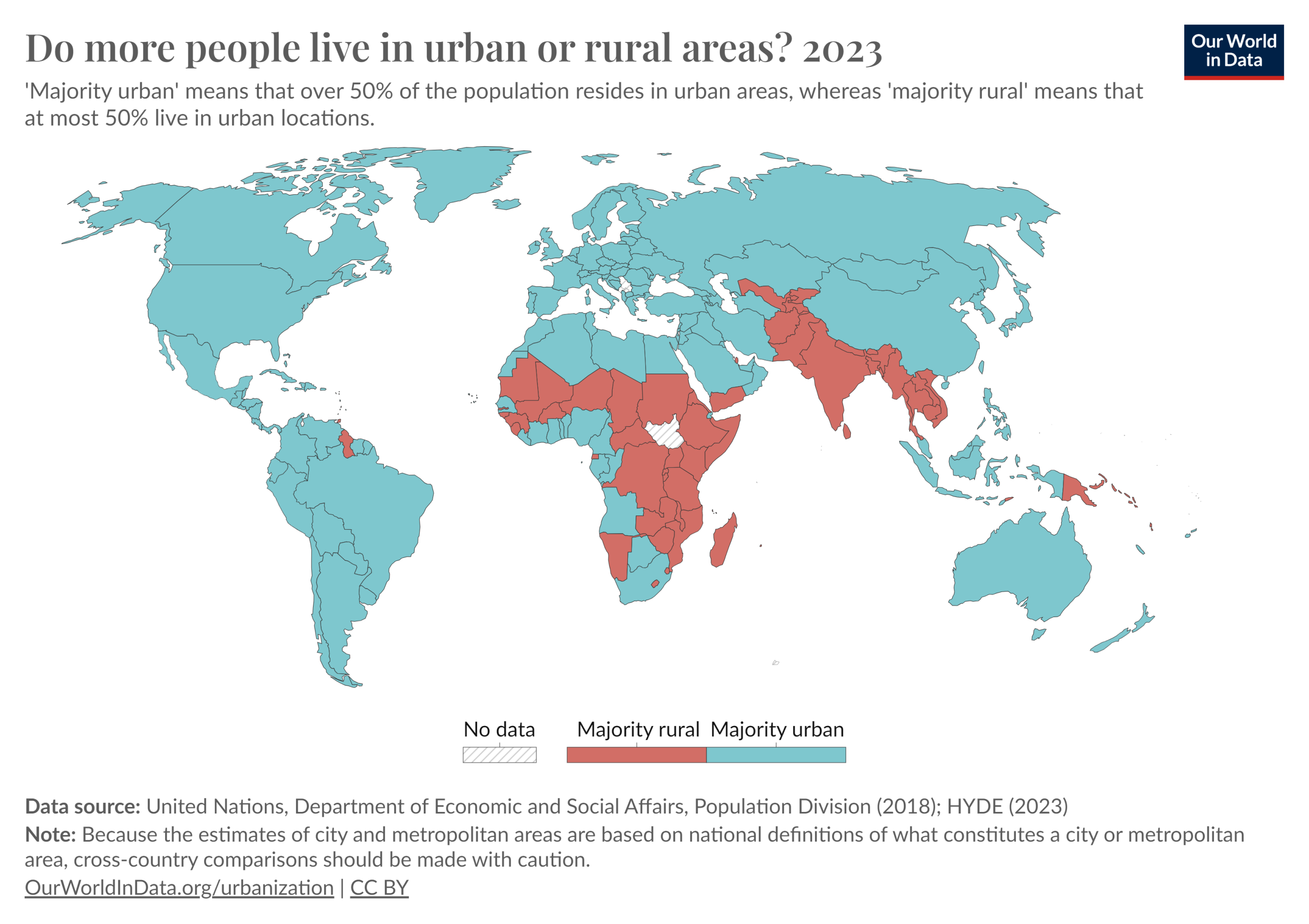
Majority of people living in urban vs. rural areas in 2050
Findings
Approaches to rural water supply have evolved, largely following and responding to the significant changes and trends observed in rural areas. Although it is difficult to generalize at a global level, several important trends from this study can be identified, which provide the backdrop against which rural water services are being managed and are evolving.
The following holds true for many low-and middle-income countries, recognizing that there are particularly difficult challenges in fragile countries with entrenched conflict and repeated extreme climate-related events that represent a specific context where such generalizations are unlikely to apply.
- Rural landscapes are changing, and expectations are rising.
- A progressive but slow transition to improving rural services.
- There is a strong correlation between economic growth and increased rural water supply coverage.
- There is a widespread recognition of the need to shift approaches to achieve SDG 6.1.
- It is also now widely understood that to achieve universal, sustainable access, more holistic approaches must be adopted, which recognize the delivery of rural water as a system.
DISCLAIMER: This report is made possible by the support of the American people through the United States Agency for International Development (USAID). The contents of this brief are the sole responsibility of The Aquaya Institute and REAL-Water consortium members. They do not necessarily reflect the views of USAID or the United States Government.