January 2025
What Drives the Performance of Rural Piped Water Supply Facilities in Ghana?
A Mixed Methods Observational Study
Background
How low- and middle-income countries manage rural drinking water supply has diversified in the last two decades. Historically, community-based management was the most common form of rural water supply facility management, in which community members are responsible for the upkeep of their infrastructure. As national water sectors have formalized, populations have grown, and the limitations of community-based management have been recognized, additional management arrangements have emerged (REAL-Water 2023). Established public utilities serve rural areas exclusively in Colombia, Ghana, Kenya, Uganda, and elsewhere. Various versions of delegated management models, in which national or local governments contract a private firm to manage and/or expand service, are active in Benin, Burkina Faso, Mozambique, Rwanda, Senegal, and Uganda. Safe water enterprises often operating as franchises or managed directly by international nonprofits backed by philanthropy—are increasingly common.
An important question for policymakers and funders is how well different rural water management arrangements perform. It has been argued that community-based management often does not achieve reliably functioning or financially sustainable water services. Nevertheless, consistent external support can improve community-based management performance. More formal water service models have theoretical advantages that could improve performance, including consolidating multiple water supplies to achieve economies of scale, attracting private and public investment, and channeling subsidies more efficiently.
The broader political economy of a country also influences the performance of rural water management arrangements. The water sector is often politicized, specifically about resource allocation, patronage, and political campaigning during election periods, which can undermine the ability of service providers to fulfill their functions (Manghee and Poole 2012; Oates and Mwathunga 2018; Hope et al. 2020). At local levels, management of water services may also be subject to rent-seeking by powerful elites (Chowns 2015; Harvey 2021; Lockwood et al. 2021).
Ghana’s current rural water management landscape results from a series of national programs, policies, and reforms dating to the 1990s. In 2017, the Government of Ghana established the Ministry of Sanitation and Water Resources (MSWR) to consolidate water, sanitation, and hygiene (WASH) development under a single ministry. Each management arrangement in this study ostensibly operates under the purview of the Ministry of Sanitation and Water Resources. District Assemblies (local government) are the service authorities for all water service provision in rural areas and small towns (with technical support and guidance from the Community Water and Sanitation Agency, meaning that they are responsible for ensuring compliance with access, service reliability, and water quality standards). District Assemblies own water infrastructure built with public funding or development assistance channeled through the government. In the case of Safe Water Enterprises, a “parent” organization that then owns the assets may bear capital costs. Under build-operate-transfer contracts with SWEs, ownership is transferred to District Assemblies after a stipulated period.
The most notable development in the performance of rural piped water in Ghana during the last decade was the Community Water and Sanitation Agency’s transition from its original role as the national rural water strategy, planning, and technical support agency to a rural and small-town service provider. Although this new role as a rural water utility is described in the current national sector development program (MSWR 2023), governing legislation approved by the national government is pending. It operates de facto and does not yet fall within a regulatory framework for utilities. Community Water and Sanitation Agency has not officially relinquished its role as a technical advisory agency for the rural water sector, including supporting District Assemblies. However, the Community Water and Sanitation Agency’s technical support activities have diminished as it transitions into a service.
This report presents the results of a cross-sectional, observational study of the drivers of rural piped water supply performance in Ghana, along with an accompanying qualitative study of how political economy factors may affect that performance. Ghana is an essential and useful site for such a study. Several management arrangements for rural piped water are operating in parallel:
- Public utility provision via Community Water and Sanitation Agency;
- Community-based management via Water and Sanitation Management Teams, supported by local governments (Metropolitan, Municipal, and District Assemblies, or simply District Assemblies); and
- Safe Water Enterprises are operated by social enterprises on market principles and supported by external aid.
Together, over 1,000 piped water supplies in Ghana fall under the three management arrangements in this study. Water and Sanitation Management Teams operate approximately 800 piped water systems and over 32,000 point water sources, such as boreholes with handpumps. The Community Water and Sanitation Agency operates approximately 179 piped water systems as a public utility. The number of Safe Water Enterprises-operated water facilities is less certain but likely falls between the Community Water and Sanitation Agency and Water and Sanitation Management Teams. Ghana is currently amidst a national debate about reforming the rural water sector, specifically which management arrangement or arrangements the government should pursue. The results of this study should inform rural water sector policymaking and practice in Ghana as well as similar debates in other countries.
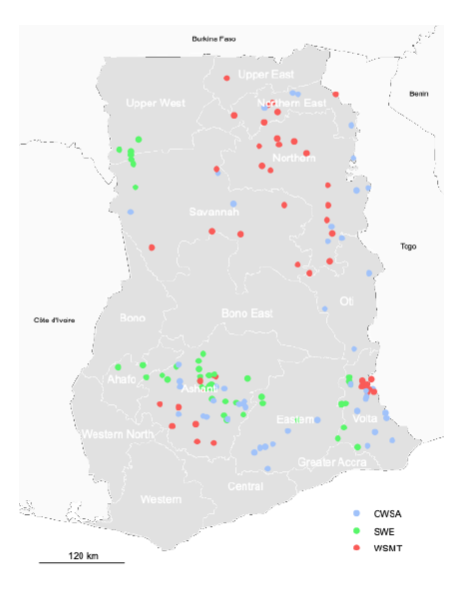
Locations of the sampled water supply facilities overlain on a map of Ghana’s regions.
Research Questions
The study poses three research questions:
- How does the performance of individual piped water systems vary among management arrangements in rural Ghana?
- What management practices and conditions account for differences in performance between management arrangements? What roles do broader contextual factors play?
- What political economy factors may explain variability in rural piped water system performance between management arrangements that quantitative surveys and field observations may not easily capture?
DISCLAIMER: This report is made possible by the support of the American people through the United States Agency for International Development (USAID). The contents of this brief are the sole responsibility of The Aquaya Institute and REAL-Water consortium members. They do not necessarily reflect the views of USAID or the United States Government.


