June 2024
What are the Good Practices for Benchmarking Fecal Sludge Management?
Benchmarking–assessing performance indicators that can be compared to targets, historical values, and other entities–has been widely adopted by large water and wastewater utilities to foster performance improvements.
Recently, cities, regulators, and others have begun adopting benchmarking for fecal sludge management (FSM). This study, undertaken by USAID/URBAN WASH, synthesizes literature and case studies to address the question: What are good practices for FSM benchmarking systems, and how should these be implemented in different institutional or governance contexts?
Multiple scales and types of benchmarking exist for water and sanitation providers, including organizational, citywide, national, regional, and international initiatives. The diversity of actors involved in on-site sanitation services often leads to a multiplicity of key performance indicators, making data collection resource-intensive and interpretation by local officials difficult. Based on an assessment of 98 indicators used across the case studies or in national or regional benchmarking initiatives, this study recommends a short list of high-priority indicators for city-level FSM benchmarking.
The research finds that FSM benchmarking is a versatile tool that can improve transparency, foster competition, strengthen advocacy, and inform financial and management decisions. However, a functioning FSM system must underpin benchmarking to drive performance improvement, requiring attention to infrastructure, regulatory standards, tariffs, organizational readiness, and communication among participating actors. Good practices expected to reinforce the sustained effectiveness of benchmarking programs revolve around selecting a limited number of consistent indicators, adequate data management systems, incentives, and public information sharing.
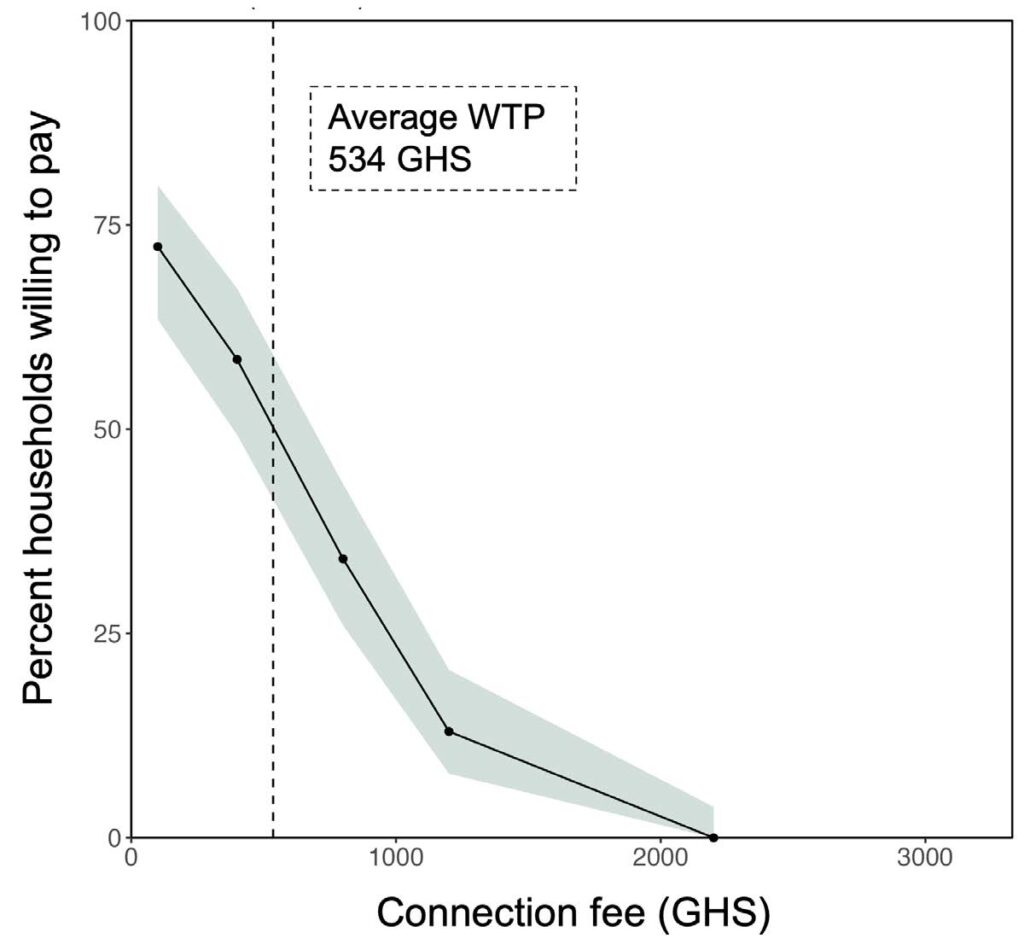
From component 2 (Water Equity and Tariffs): A graph indicating the willingness to pay for Ghana Water Limited’s connection fee among Non-Customers in Kumasi, Ghana (n = 123, Owners Only)
Findings from this study will be used to identify opportunities and design pilot interventions to improve urban water service delivery.
The three reports produced by USAID/URBAN WASH are below.