February 2026
How to Stop the Flow of Lead in New and Existing Drinking Water Systems
Hoponick Redmon J, Salzberg A, De France J, Alvarez-Sala J, Murray A, Peletz R, et al. (2026) How to stop the flow of lead in new and existing drinking water systems. PLOS Water 5(2): e0000497. https://doi.org/10.1371/journal.pwat.0000497
Since 1991, World Water Week has convened global experts to address critical water challenges and underscore the importance of water, sanitation, and hygiene (WASH) globally, often centered around water resource management and microbial safety. There is also increasing recognition of the need for safeguards to prevent chemical contaminants in drinking water, including lead (Pb), as lead exposure causes a profound impact on global health and economic productivity. A third of children globally are significantly impacted by lead exposure, and even small amounts of lead exposure can cause lasting and irreversible damage. Preventing and mitigating lead in water systems will help reduce this impact. Drawing on key insights discussed during the last two World Water Week’s and University of North Carolina Water & Health conferences, we articulate the urgency of coordinated global action to eliminate exposure to lead contamination in drinking water systems worldwide.
Lead uses and contamination sources
Lead is a metal that has been or continues to be mined and used in products such as paint, gasoline, batteries, and water infrastructure piping and plumbing. Both current and legacy uses contribute to contamination of drinking water, soil, air, dust, and consumer products, including spices and cosmetics. Lead in drinking water is a source water concern near contamination hot spots. However, the primary source of lead in drinking water is lead-containing system components and plumbing materials that leach lead into the water supply. These sources are preventable by using lead-free materials in new systems, addressing legacy infrastructure, and instituting consistent standards and enforcement.
Effects of lead exposure
Lead exposure is well known to cause irreversible, lifelong effects — from intellectual disabilities to cardiovascular disease. As there is no identified safe lead level, reducing lead exposure is essential for public health, as lead harms nearly every system in the body. Infants and young children are especially vulnerable to irreversible harm from lead exposure, especially in chronically undernourished children.
WHO estimated that nearly half of two million deaths from chemical exposure in 2019 were due to lead. Approximately 800 million children — one in three worldwide — have blood lead levels above 5 µg/dL, and lead exposure is attributed to over 30% of developmental disabilities in children, prompting WHO’s recommended action to identify and reduce exposure sources. WHO classifies lead among the top 10 chemicals of major public health concern, with specific lead in drinking water guidance. The health and economic burden of early childhood lead exposure is highest in low- and middle-income countries (LMICs), prioritizing action to reduce exposure from all sources, including drinking water.
Presence of lead in drinking water systems
Lead in drinking water affects higher and lower wealth countries, along with urban and rural areas. It is overwhelmingly linked to water infrastructure —the very piping and plumbing that delivers water to taps, wells, and handpumps, thereby becoming a long-lasting community health hazard. Mounting evidence shows lead contamination is widespread in drinking water globally, with an estimated 25% of global samples surpassing the WHO provisional guideline of 10 μg/L — set as a practical limit given the presence of lead-based materials. In the U.S., aging water infrastructure in one state led to 12% of childcare facilities containing first-draw tap water above the WHO limit, especially for older buildings and well water users. Across Europe, both historical and ongoing use of lead-containing pipes and fittings remain significant sources of exposure.
Common water system parts in rural LMICs, such as galvanized handpump spouts and brass taps, frequently fail to meet international standards for lead leaching. Component scrap samples in a recent African well pumps study revealed that 51% of foot valves and 45% of tap spouts contained lead above 0.25% Pb. In Central America’s largest city, 8.9% of first-draw tap water exceeded WHO guidelines, primarily due to lead-containing household plumbing. Critically, lack of data in some regions does not mean lack of risk, underscoring the need for proactive reduction efforts. Preventing lead contamination by ensuring new water fixtures and systems are lead-free is also critical.
Shifting to lead-free water infrastructure components globally
The primary source of lead in drinking water is not the original water supplies — it is lead-containing system components and plumbing materials that leach lead into drinking water. Exposure from these sources is entirely preventable by using verified lead-free materials in new systems and addressing legacy infrastructure containing lead. While efforts to formalize markets and improve supply chains for lead-free components are underway, significant regulatory gaps remain or are inconsistent, which results in continued installation of lead-containing parts. National technical regulations should set clear minimum requirements based on international standards, with enforcement mechanisms to ensure compliance. International forums, including recent United Nations and Asia Pacific Economic Cooperation (APEC) meetings between 2023–2025, demonstrate a growing commitment to reduce lead in plumbing and strengthen supply chains.
Mitigating existing water infrastructure
To address lead in current water systems, targeted water sampling, laboratory analysis, risk mitigation, water treatment, communication, and multisectoral collaboration with governments, parts suppliers, water utilities, and communities is possible. To enable large-scale testing and effective risk reduction programs, centralized monitoring, standardized protocols, and region-specific mitigation strategies are key. Since lead contamination is invisible and varies, tap-level monitoring is vital to identify mitigation needs. Actions could include using alternative taps for consumption, regularly flushing, introducing corrosion control, and replacing affected fixtures.
Moving forward
Preventing lead-containing components from entering water supply chains is strongly recommended to prevent lead in new drinking water systems. Implementing this process is considerably less costly, time-intensive, and challenging than continuing to install leaded components and address exposure issues later (or potentially not at all). Since existing water systems still pose a known lead exposure risk, the optimal strategy involves a dual approach:
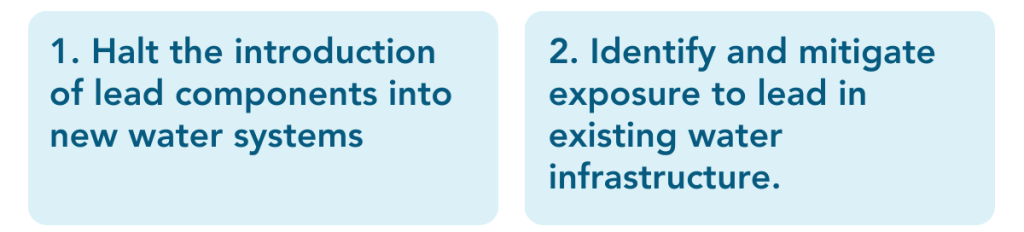
This combined method not only safeguards public health but also streamlines efforts toward a lead-free future. National governments should prioritize preventing and reducing lead in drinking water as part of broader efforts to limit cumulative lead exposure from all sources.
In summary, tackling lead exposure in drinking water is an urgent, yet solvable public health priority that demands coordinated, cross-sector action. The global initiative for lead-free drinking water calls on governments to commit and enforce standards and policies, industries to improve supply chain standards, researchers to advance science and implementation strategies, and cross-sectoral organizations to ensure objectives are implemented. Achieving a lead-free future requires broad collaboration, robust implementation, and strengthened supply chains—key goals and efforts underway with the Global Lead-Free Water Initiative and the broader Partnership for a Lead-Free Future.