August 2023
Can Pro-Poor Subsidies Enhance Water Access in Ghana?
Pro-poor subsidies is a term used in development literature to describe policies that target poor people or aim to reduce poverty. In the Accra metropolitan area of Ghana, fewer than 30 percent of households in low-income urban and peri-urban settlements have access to piped water services, well below the government’s stated aim for 70 percent of urban/peri-urban households to have access to piped water by 2030. Some of the main challenges with supplying water to low-income urban and peri-urban settlements include inadequate policy and legislative frameworks and unaffordable lump sum connection fees.
To address these equity and inclusion challenges, USAID’s Urban Resilience by Building Partnerships and Applying New Evidence in WASH (URBAN WASH) activity is partnering with Ghana Water Company Limited to understand, document, and disseminate lessons from the utility’s recent water connection subsidy projects in Accra. USAID’s URBAN WASH Activity is partnering with Ghana Water Company Limited to understand, document, and disseminate lessons from the utility’s recent water connection subsidy projects in Accra to address these equity and inclusion challenges
This inception report summarizes the literature on pro-poor water subsidies, describes Ghana’s pro-poor water delivery policies and approaches, and outlines URBAN WASH’s research and learning approach.
This research will use lessons to inform future iterations of Ghana Water Company Limited’s pro-poor programs and potentially enable other countries to learn from Ghana Water Company Limited’s experience.
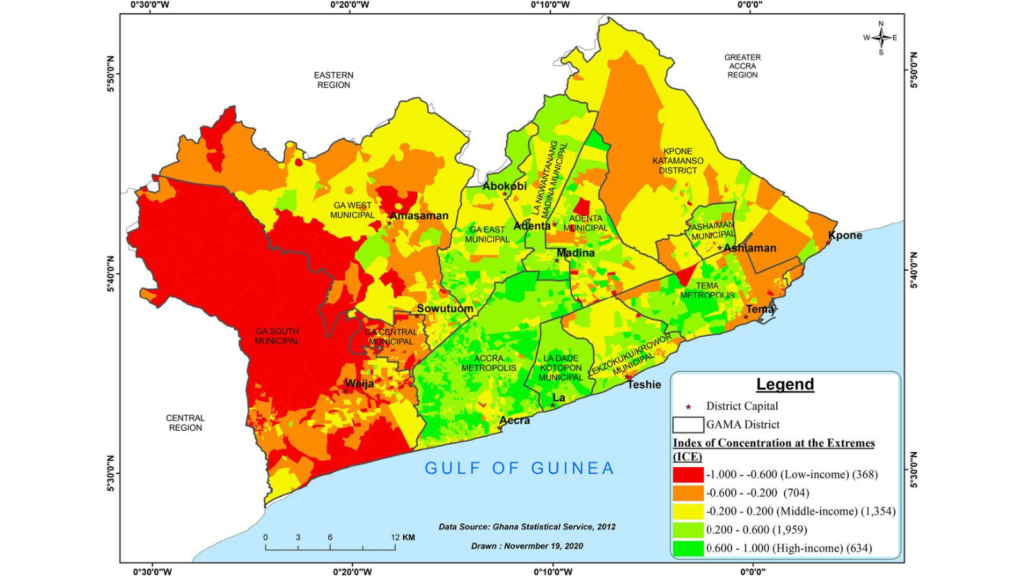
Map of Greater Accra metro area showing poverty variance given by the index of concentration at the extremes, a measure of spatial social polarization
Research questions
Impact: To what extent did connection subsidies increase water access and improve livelihoods among households in targeted Low-Income Urban Communities?
Finances: (A) To what extent did the subsidized connections impact Ghana Water Company Limited’s revenue collection efficiency? (B) How much funding would be required to expand and sustain the program city-wide, and what strategies could fill the funding gap while lowering reliance on donor funding?
Strategies for future programs: (A) What barriers do the urban poor, particularly women, renters, or marginalized groups, face in accessing connection subsidy projects? How can program implementation be adjusted to lower these barriers? (B) What barriers does Ghana Water Company Limited face in administering the subsidy projects and what strategies could address these institutional challenges?