July 2025
Assessing the Safety of Piped Water in Lira
Survey from February 2025
Lira District is a district in Northern Uganda, named after its main town, Lira. It shares borders with Pader, Otuke, Alebtong, Dokolo, Apac, and Kole Districts.
WaterTRACS has been coordinating longitudinal water quality monitoring in two target districts in Uganda since 2022. In February 2025, Aquaya conducted a sixth round of surveys and water quality testing. The surveys covered households, water points, schools, and healthcare facilities across the district. This effort builds upon prior monitoring.
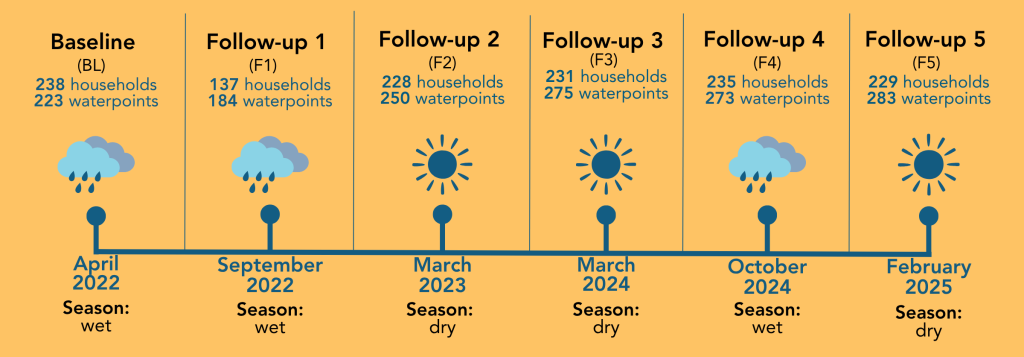
Timeline of drinking water samples tested in Lira District, Uganda
Background
This research focuses on piped water systems, the second most common drinking water source in Lira. In February 2025, 29% of households used piped water. Piped water use increased from 18% in late 2022 to 29% in early 2025. In contrast, boreholes with handpumps remained the most common source. By early 2025, 73% of households used boreholes, up from 53% in 2022.
Meanwhile, nearly all schools (87%–96%) and healthcare facilities (82%–91%) relied on boreholes for drinking water. Only a few institutions reported using piped water during this period.
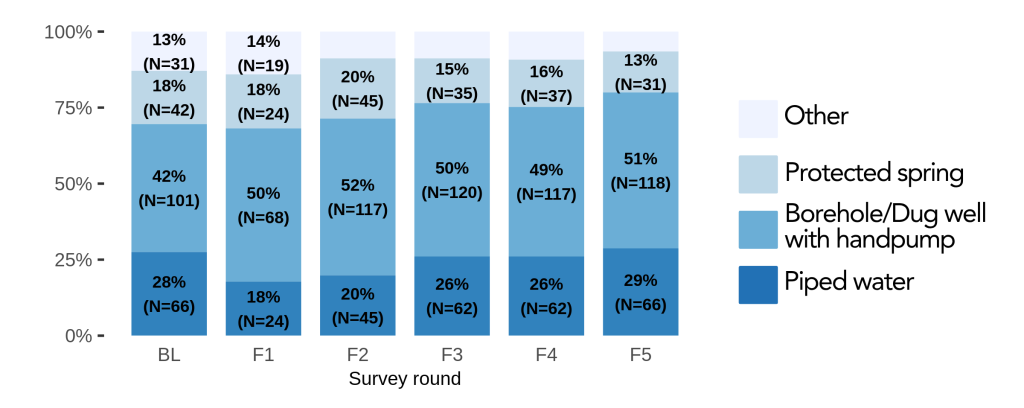
Current drinking water sources of surveyed households at each sampling time in Lira (including Lira City and Lira District), including piped water, boreholes and dug wells with handpumps, protected springs, and other source types.
Results
Water service reliability
Across all study visits, three-quarters of piped system taps had water available (n=316). Availability was highest in early 2022 (BL), when 94% of taps had water available (n=47), and lowest in early 2023 (F2) when only 55% had water available (n=53). About 40% of the time, many waterpoints lacked water because caretakers closed them or shut them off, meaning either the caretaker was not present or the respondent was unaware of a specific reason.
Microbial water quality
Piped water supplies have been among the safest waterpoint types at all sampling times. Microbial presence has varied between sampling events, from a low of 6% to a high of 74% of samples with E. coli present, with no straightforward correlation to seasons. We found E. coli contamination has been present in 6% of piped samples collected directly from taps across all study visits.
Chlorination
Across all sampling times, free chlorine residuals were low to moderate, with 7% to 52% of sampled taps having the minimum recommended value of 0.2 mg/L set by the Uganda national drinking water standard.
In February 2025 (F5), 94% of piped water samples had detectable total chlorine (TCR ≥0.1 mg/L), indicating nearly all piped supplies were being treated with sufficient chlorine for some disinfection to occur.
On-plot piped water and household storage
Throughout the study period, 10% of households reported having on-plot piped connections and used them for drinking water.
However, storing piped water at home often worsened water quality. For example, among users of off-plot public taps, E. coli presence rose from 18% at the tap to 83% in stored water. Similarly, for on-plot taps, contamination rose from 58% to 81% after storage. This highlights the need for safe storage and stronger residual chlorine protection.
Recommendations
- Piped water service reliability should be improved such that water service is provided more regularly.
- Chlorination should be performed at higher levels to ensure a free chlorine residual stays above 0.2 mg/L throughout the piped network, especially during the wet season.
Learn more about our water quality results in
WaterTRACS is supported by funding from the Conrad N. Hilton Foundation.