July 2025
Assessing the Safety of Piped and Packaged Water in Asutifi North
Survey from February 2025
Asutifi North District is one of six districts in Ghana’s Ahafo Region. Originally created as a single district in 1988, it was split in 2012.
WaterTRACS has been coordinating longitudinal water quality monitoring in two target districts in Ghana since 2022. In February 2025, Aquaya conducted a sixth round of surveys and water quality testing at households, water points, schools, and healthcare facilities in Asutifi North District. This effort builds upon prior monitoring.
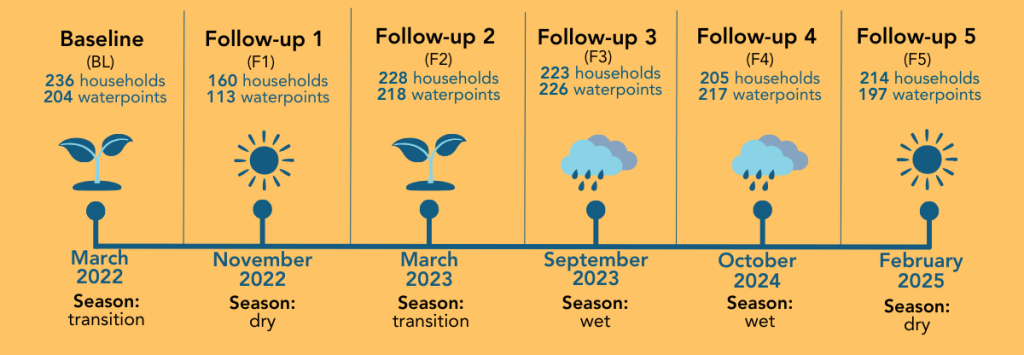
Timeline of drinking water samples tested in Asutifi North District, Ghana
Background
This research focuses on piped water and packaged water, the two most common sources of drinking water in the Asutifi North district, which were collectively used by 65% of households in February 2025. Packaged water consumption has increased substantially, from 7% in late 2022 to 40% in early 2025, while the use of piped water for drinking has decreased since 2022 (from 38% to 25%).
Piped water use in schools remained more consistent, ranging from 41% to 57% (n=49). In contrast, very few schools relied on packaged water. Healthcare facilities reported using a mix of both piped and packaged sources.
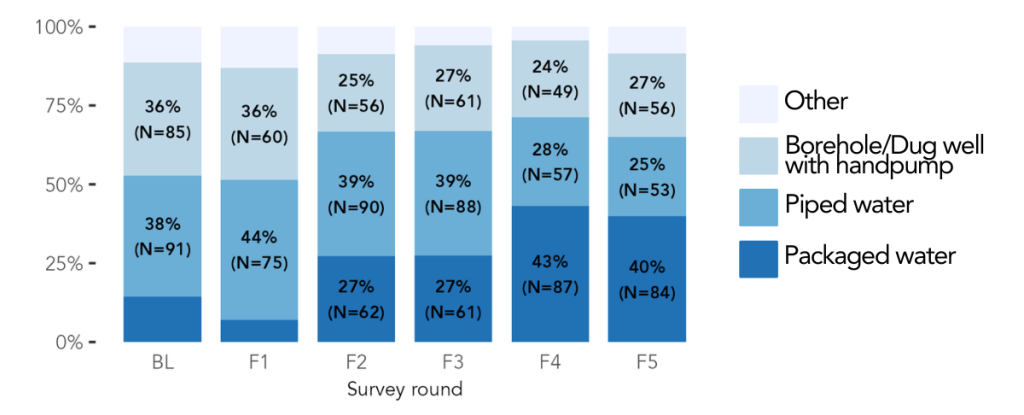
Current drinking water sources of surveyed households at each sampling time in Asutifi North, including packaged water (sachet and bottled), piped water, and other source types.
Results
Microbial water quality | Piped water
Piped water supplies have been among the safest waterpoint types at all sampling times, though microbial presence varied between sampling events, from a low of 20% to a high of 53% of samples with E. coli present.
In early 2025 (F5), 20% of piped samples collected directly from taps had E. coli (n=91); however, a much higher proportion (87%) of piped samples collected from household storage containers (n=53) had E. coli.
Chlorination
Across all survey rounds, free chlorine residuals were consistently low. Only 1% to 15% of taps met Ghana’s recommended minimum of 0.2 mg/L.
In February 2025, only 16% of piped samples had detectable total chlorine (TCR ≥0.1 mg/L). This suggests that while some chlorine treatment occurred, it often wasn’t strong enough to maintain protection.
On-plot piped water
About 19% of households had on-plot piped connections. However, only 10% of them used this water source for drinking.
Unfortunately, storing on-plot piped water reduced its microbial quality. E. coli contamination increased from 41% at the tap to 82% after household storage. This suggests that household storage methods are critical to ensuring water safety.
Microbial water quality | Packaged water
Packaged water consistently showed the lowest levels of contamination among all sources. In February 2025, only 6% of sachet or bottled samples tested positive for E. coli.
Nonetheless, contamination was observed across multiple sachet brands. This highlights the need for stricter quality control even within commercial water supplies.
Recommendations
- All piped water supplies should be chlorinated.
- Chlorination must be more consistent and at higher levels to ensure a free chlorine residual stays above 0.2 mg/L throughout the piped network.
- Unless piped supply treatment improves substantially, sachet water remains the safest option for preserving water quality during household storage.
Learn more about our water quality results in
WaterTRACS is supported by funding from the Conrad N. Hilton Foundation.