July 2024
As Water Stresses Increase, Rural Water Development Requires More Coordination Across Water Use Sectors
Lessons from India’s Jal Jeevan Mission
In 2019, the Government of India launched the ambitious Jal Jeevan Mission to bring functional tap connections to every rural household in the country by 2024. Extending piped supplies to India’s estimated 194 million households will increase water demand in water-scarce areas and increase graywater discharge in unsewered rural settlements. The Jal Jeevan Mission specifies Annual Action Planning methods for village, district, and state governments to guide local, state, and federal drinking water investments.
USAID’s REAL-Water project assessed these approaches nationally and in four states: Bihar, Karnataka, Maharashtra, and Sikkim. Despite standardized Jal Jeevan Mission planning formats, each state has distinctive water institutions, capacities, gaps, and opportunities for multi-sector collaboration that shape drinking water service sustainability. The states have promising initiatives, such as scientific agencies for groundwater mapping and monitoring, as well as water resources management and conservation programs. However, no state has focused on coordination with other water use sectors for the long-term functionality of rural drinking water systems. The states need additional planning efforts to monitor and improve the functionality of rural water systems and to increase coordination across sectors at each level of governance. To ensure the legacy of Jal Jeevan Mission investments, planning efforts should address expanding agricultural, industrial, and environmental water demands and rapidly changing socioeconomic and climatic conditions.
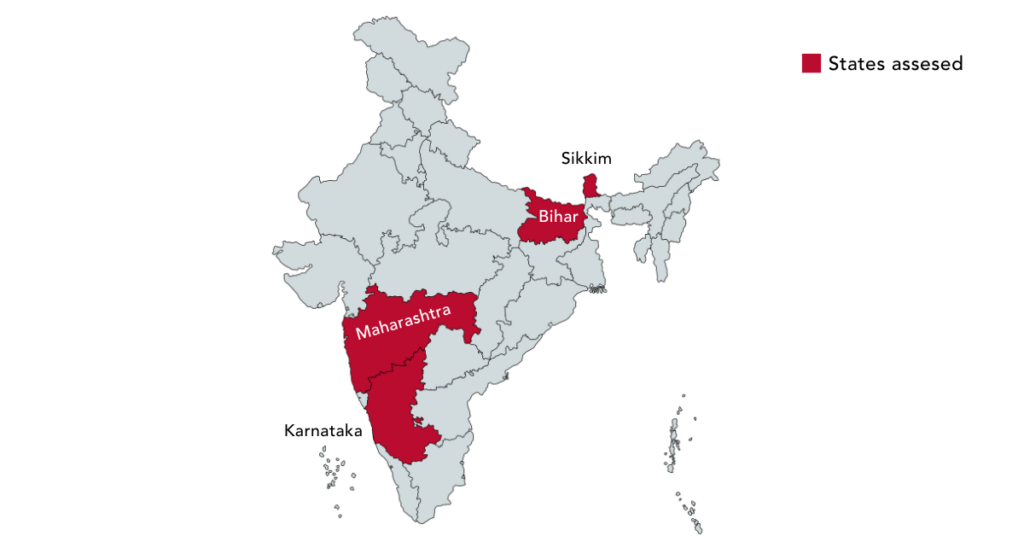
The map of India below highlights the four states assessed by REAL-Water: Bihar, Karnataka, Maharashtra, and Sikkim. Each state showcases unique water management initiatives and challenges under the Jal Jeevan Mission.
What Can You Do About It?
- Scale up tap and piped water functionality assessments and adapt annual action planning to address sustainability issues. Jal Jeevan Mission’s 2022 functionality assessments mark an important advance from documenting tap coverage to evaluating key water service variables. These assessments provide feedback on the effectiveness of drinking water interventions. However, the Jal Jeevan Mission should add additional source sustainability and financial management variables to future functionality assessments. Source sustainability variables will help identify and prioritize multi-sector water resources management areas. While most districts in each state have received some attention (~19 villages per district), larger sample sizes are necessary to support functionality plans for districts with hundreds to a thousand villages. In addition to current third-party sampling, the three levels of local Panchayati Raj governments could help scale up functionality assessments to diagnose and address sustainability issues directly in their annual and medium-term plans. Future Annual Action Plans should incorporate growing Jal Jeevan Mission expertise in specific sustainability topics (e.g., construction quality, operations, maintenance, operator skills, sensor data, and community training).
- Strengthen the links between rural drinking water planning and multisector water resources management in annual and medium-term planning. Rural drinking water authorities cannot expect to sustain water supply sources in isolation from larger water use sectors. We identified several state-specific opportunities for convergence between rural drinking water planning and other water use sectors, and there are no doubt others. For example, the national Atal Bhujal Yojana program supports community-based aquifer management that could extend to more states. Bihar’s Jal Jeevan Hariyali supports water harvesting and conservation programs that the state’s rural water supply planning could incorporate (Down to Earth 2021). Sikkim has developed spring-based water management innovations in remote and hilly areas that will improve the sustainability of drinking water supplies and may have relevance for comparable areas in other states. The Maharashtra Ground Water Surveys and Development Agency and Maharashtra Remote Sensing Applications Centre have developed multiple scales of groundwater potential and water asset mapping. Karnataka, likewise, has an expanding Remote Sensing Applications Centre, which could help state and district water agencies develop GIS capabilities to model and visualize multi-sector water planning issues and opportunities. Integrating these multi-sectoral approaches in national, state, and local action plans will improve the likelihood of widespread and sustainable gains in drinking water services in rural India. This multi-sector goal will require greater emphasis on medium-term plans (5 to 15 years) at all levels.
Lessons from India’s Jal Jeevan Mission
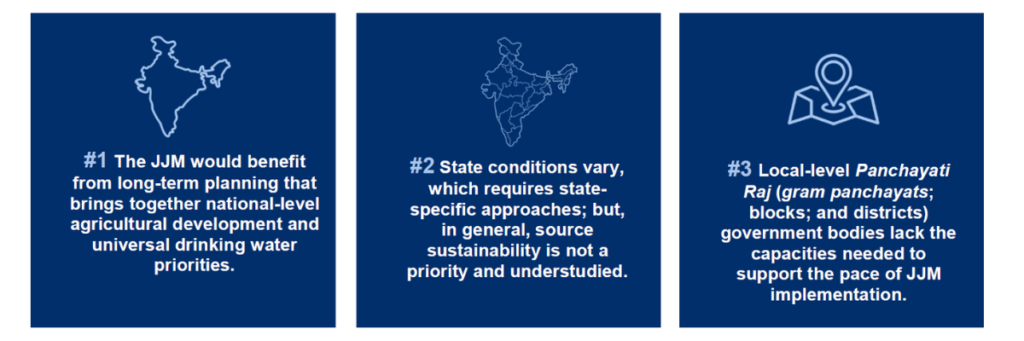
Nationally, The Jal Jeevan Mission Annual Action Planning framework is well documented in online guidelines, administrative documents, technical reports, dashboards, and the Mission’s integrated management information system (Government of India 2019, 2023, 2024). These regularly updated government resources report that tap water coverage increased from 16.6% in 2019 to 71.9% in December 2023 (Jal Jeevan Mission dashboard). A 2022 third-party evaluation found that 86% of households had taps, but only 62% of the households with taps met the water service and water quality standards needed to be “fully functional” (Kantar Public 2022). The independent evaluation indicates that the installation of household tap connections does not guarantee sustainable water services.
State-level planning institutions vary, as water is constitutionally a state subject in federal countries like India. Stakeholders in Bihar, Karnataka, Maharashtra, and Sikkim identified important differences in the institutional setup of drinking water departments: some have stand-alone units, others belong to broader rural development agencies (Bihar and Karnataka). Integration of drinking water departments with state water resources departments responsible for irrigation, river basin, and multi-sector planning does not currently exist. States also vary in their water resources contexts. Maharashtra and Karnataka have complex hard rock aquifers and drought-prone regions, Bihar has alluvial aquifers, and Sikkim relies upon mountain springs. Some states (e.g., Karnataka) have areas where groundwater pumping is classified as critical (90-100% of recharge) or overexploited (>100% above recharge), driven by a lack of groundwater regulation and subsidized energy costs for pumping (Srinivasan et al. 2023). Some states have strong scientific agencies for groundwater mapping and management, such as Maharashtra’s Ground Water Surveys and Development Agency. Some states focus on single-village schemes; others are developing larger multi-village schemes.
Local-level Panchayati Raj institutions include villages also known as gram panchayats; blocks that encompass tens to hundreds of villages; and districts that oversee tens of blocks and thus hundreds to thousands of villages. These local levels of government implement rural drinking water and sanitation programs, but they have limited planning capacity (e.g., for social research, statistical analysis, strategic planning, or GIS visualization), especially for complex multi-village schemes that require coordination among sectors (Wescoat and Murty 2021). The rapid implementation mode of “missions” such as Jal Jeevan Mission outpaces comprehensive planning at village, block, and district levels. Inputs from Implementation Support Agencies hired to help prepare village plans are uneven and likely unsustainable after Jal Jeevan Mission finishes. Block and district staff have limited capacity to identify innovative alternatives, analyze and visualize planning issues with GIS mapping, and prioritize villages systematically for different types of investment and support. Strengthening these local institutional capacities lays a foundation for coordinated planning across water use sectors.
This report is made possible by the support of the American people through the United States Agency for International Development (USAID). The contents of this brief are the sole responsibility of The Aquaya Institute and REAL-Water consortium members. They do not necessarily reflect the views of USAID or the United States Government.