January 2025
AI in Water and Wastewater Sectors
Authorship contribution: George Wainaina, Joel Podgorski, Linda Strande, Christoph Lüthi (Eawag), James Elliot Brown (SWOT), Olivier Mills (WASH AI), Karen Setty, Chloé Poulin (Aquaya)
Introduction
Artificial intelligence (AI) has been with us since the 1950s. Its application in water quality, quantity, and access can be traced to 1990. However, it is only now gaining traction in day-to-day applications. This brief highlights select AI, limitations, and potential for research and practice in predicting the quality of surface and subsurface waters. It further demonstrates AI’s applications that have emerged for day-to-day use in the water and wastewater sectors and their potential impact.
“…deep learning has the potential to solve challenges by filling in spatial and temporal data through training to improve its predictions about surface water. ”

Background
A recent review paper by Joel Podgorski from Eawag and others highlighted the applications and potential of AI, specifically deep learning, inland surface and subsurface waters’ (including drinking and polluted water) research and practice. This was essential since intensive and extensive water quality data collection is manually demanding, expensive, and often not conducted in accredited laboratories where independent verification is possible. Therefore, its quality is questionable. In addition, over three-quarters of global data on total suspended solids is sampled from less than a fifth of the rivers worldwide, and the sampling predominantly takes place in North America. Lastly, water quality monitoring does not capture the water quality of the whole river in time and space.
The researchers concluded that deep learning has the potential to solve these challenges by filling in spatial and temporal data through training to improve its predictions about surface water. It could also predict data-scarce variables from similar datasets with richer subsurface water quality from catchment properties.
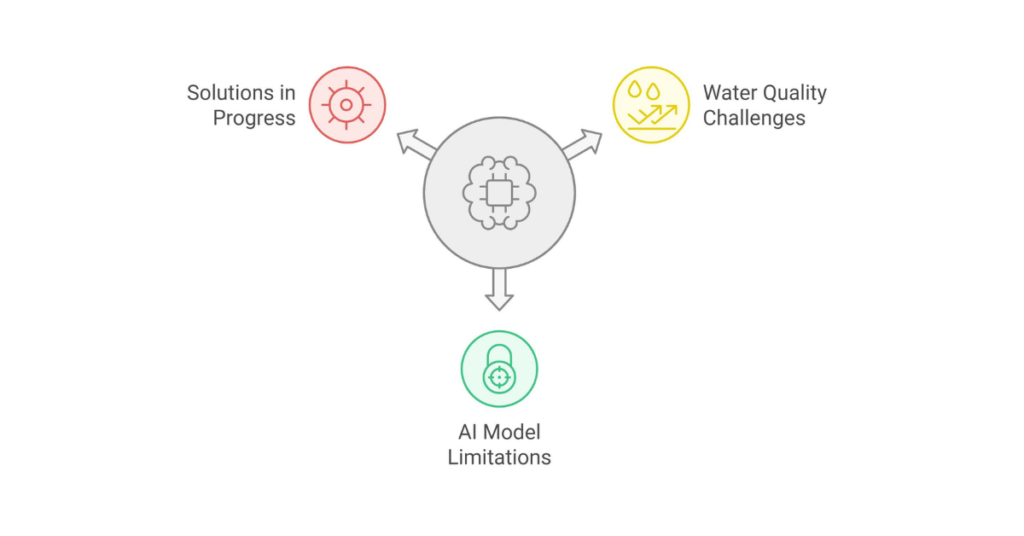
While this is promising, these AI models, in general, face two challenges:
- They can only correctly predict within the constraints of their training data. This is also the case for large language models, such as Chat GPT, which often cannot provide meaningful information beyond their training data.
- They have been criticized as “black boxes,” i.e., users often have no idea what is happening in the background.
These two reasons reduce people’s confidence and trust in them, consequently limiting AI uptake and use.
However, researchers are working on the two challenges. Process-guided deep learning and differentiable modeling resolve the training-data-constraints challenge, while explainable deep learning approaches tackle the black box challenge.
- Process-guided learning ensures that the model has domain-specific training and “punishes” deviation from established processes by stakeholders.
- Differentiated models include physically meaningful parameters and equations that can be inspected and manipulated.
- Explainable deep learning approaches aim to resolve the black box challenge by evaluating the model’s reasoning,’ interpreting model decisions, and extracting patterns and drivers.
Yet, this is a work in progress in the water field and beyond. The paper elaborates on both solutions for those interested.
Selected Examples of AI Use in the Water and Wastewater Sectors
In practice, four examples of the use of AI (machine learning and large language models) in the water and sanitation sectors seem promising. These are expounded in the following sections but are not an exhaustive list. They include:
- Safe Water Optimization Tool
- Faecal Sludge Snap App
- WASH AI
- Smartphone App for Identifying Poor Rural Households in Ghana
Safe Water Optimization Tool
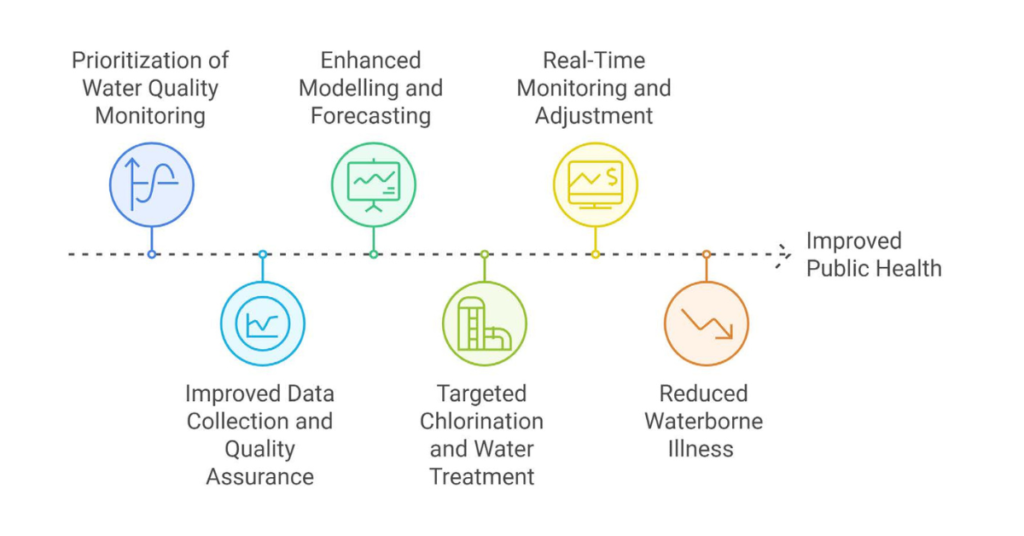
The Safe Water Optimization Tool (SWOT) is a web-based water quality modeling and assurance platform that helps WASH teams ensure drinking water safety over the last mile of distribution – from collection to the point of consumption.
Faecal Sludge Snap App
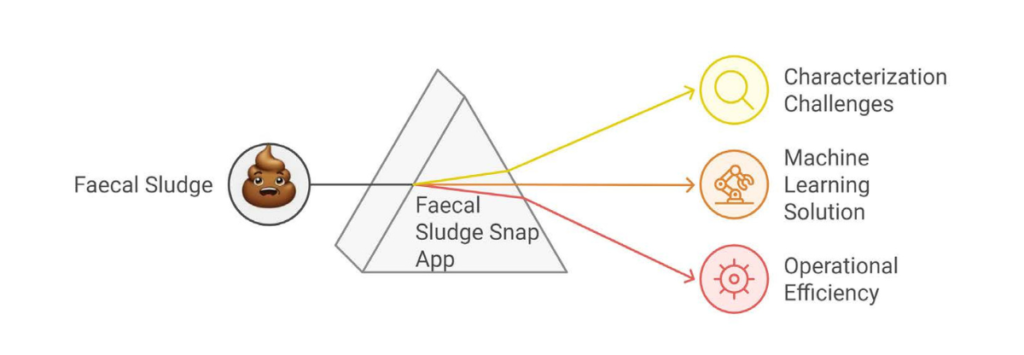
The Sludge Snap App, in its Beta version, was developed at Eawag. It is a promising solution that employs a machine learning approach to characterizing wastewater. The user takes a picture of the sludge, and the app integrates image processing to use color and texture with a machine learning model to provide rapid, on-site predictions of fecal sludge characteristics, aiming to support operational efficiency.
WASH AI
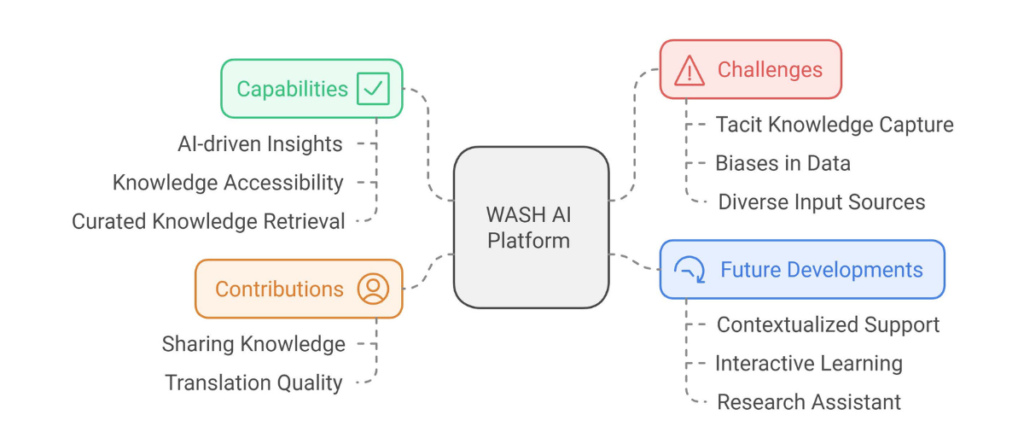
WASH AI, an initiative of Baobab Tech, seeks to transform knowledge management in the Water, Sanitation, and Hygiene sectors using generative artificial intelligence. The platform’s capabilities are designed to offer comprehensive, context-specific insights in the following ways: AI-driven insights to facilitate informed decision-making of diverse practitioners, it enhances knowledge accessibility by building support in over 20 languages and adapting information to the user’s context and expertise level and it provides an accurate knowledge retrieval service.
Smartphone App for Identifying Poor Rural Households in Ghana
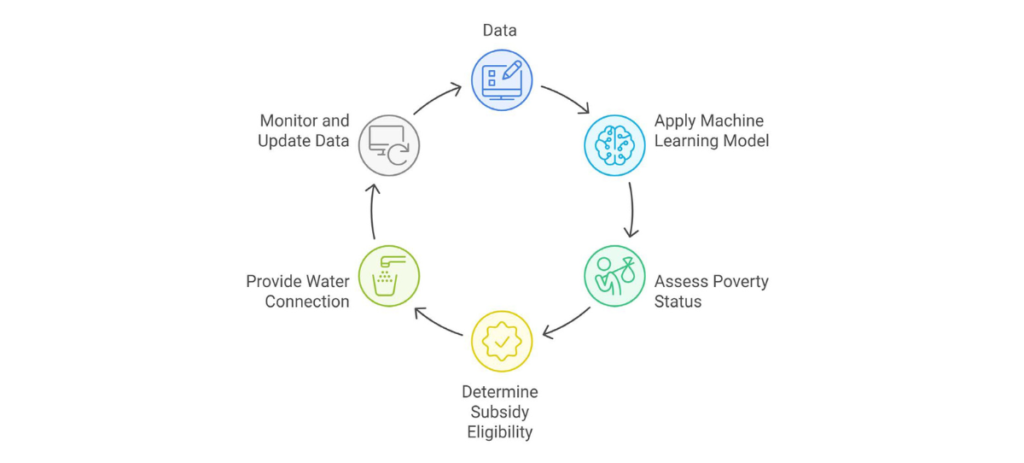
Determining which households require financial support remains challenging due to variable definitions of poverty, differences in living standards among locations, and subjective eligibility criteria. Aquaya developed a machine learning–based tool to support subsidy eligibility screening at the rural household level. By applying feature reduction techniques to the Ghana Living Standard Survey, which holds over 600 proxy questions related to a household’s assets and living conditions, Aquaya reduced the number of indicators to 47 that effectively correlated with poverty status.