January 2025
How Can Strategic Interventions Improve Water Supply in Madagascar?
Management Opportunities Report
According to the World Bank, Southern Madagascar faces significant water challenges, with only about 54.4% of the population accessing vital water services in 2022. Improving the water supply in Madagascar remains crucial to addressing these ongoing issues and ensuring sustainable development.
This report by REAL-Water presents strategic recommendations for improving southern Madagascar’s rural water supply management systems. The report identifies key challenges, outlines programming opportunities, and proposes solutions to water supply issues in water-stressed areas, particularly in alignment with the new USAID Rano Maharitra project.
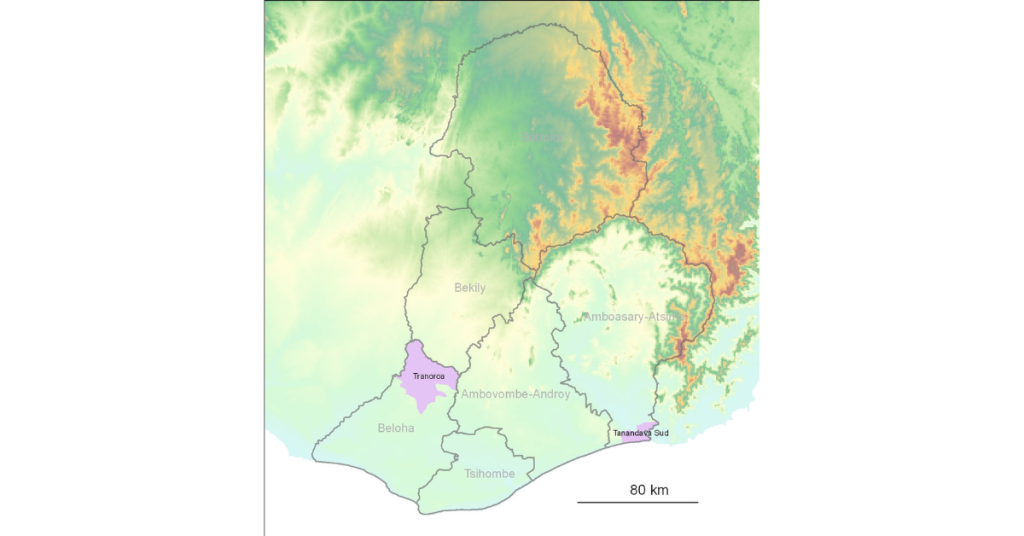
A map of southern Madagascar highlights potential local activity trial target locations. Two areas are marked in purple: Tranoroa, located in the western region near Beloha and Ambovombe-Androy, and Tanandava Sud, situated in the southeastern area close to the border of Amboasary-Atsimo.
Key Findings
Although surface and groundwater availability challenges remain across the Grand Sud, the most pressing challenges we identified are weak rural water supply management systems. In parallel, widespread and rapid infrastructure rehabilitation works currently underway overwhelm the limited local institutional capacities. Specific problems include:
- Systemically dysfunctional village-level water supply infrastructure, including those rehabilitated within the last few years;
- A lack of technical and management capacity on the part of communes and communities to manage and maintain their own small-scale village supplies (boreholes installed with manual pumps). We note an absence of O&M from the World Bank’s water infrastructure plans, which could represent a programming gap for USAID to consider filling;
- A lack of administrative, financial, and technical capacity in communes and the Direction Régionale en Eau, Assainissement et Hygiène (DREAH)s to manage and effectively regulate affermage contracts;
- Underperforming private operator technical and management services, in large part due to inadequate tariff recovery;
- Widespread lack of commune and community readiness to transition from informal water supply system management to formal management (with rigid payment requirements);
- A lack of effective operational coordination mechanisms among donors and implementers within the sector; and
- BHA’s recently rehabilitated water points across Beloha and Tsihombe districts (Androy Region) are now non-functional. There are opportunities for collaboration between the USAID/HPN and USAID/BHA teams that reinforce integrated humanitarian/ development NEXUS programming.
DISCLAIMER: This report is made possible by the support of the American people through the United States Agency for International Development (USAID). The contents of this brief are the sole responsibility of The Aquaya Institute and REAL-Water consortium members. They do not necessarily reflect the views of USAID or the United States Government.