July 2024
What is the Water Quality in Lira District, Uganda?
Surveyed March 2024
Lira District is a district in Northern Uganda. Like many other Ugandan districts, it is named after its ‘chief town,’ Lira. Pader District borders Lira District to the north, Otuke District to the northeast, Alebtong District to the east, Dokolo District to the southeast, Apac District to the southwest, and Kole District to the west.
The Aquaya Institute is coordinating longitudinal water quality monitoring in two target districts in Uganda (WaterTRACS). In March 2024, Aquaya conducted surveys and water quality testing at households, water points, schools, and healthcare facilities in Lira District. This effort builds upon prior monitoring.
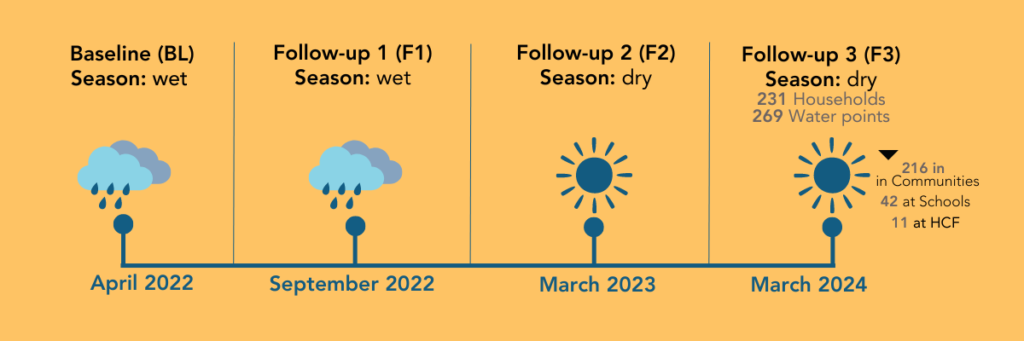
Timeline of drinking water samples tested in Lira District, Uganda
Water points
We conducted surveys and tested E. coli at 269 water points in February 2024. Over one-third of water samples (38%) were free from microbial contamination, defined as E. coli <1 CFU/100 mL, consistent with previous survey rounds. Water from boreholes with hand pumps was safest (66% free from E. coli), and water from springs and surface water was least safe (none free from E. coli). Across all survey rounds, water from boreholes with hand pumps and piped systems was consistently safer than water from other sources. Water from dug wells was safer in the dry season (F2, F3) than the wet season (BL, F1), while water from piped water systems was safer in the wet season.
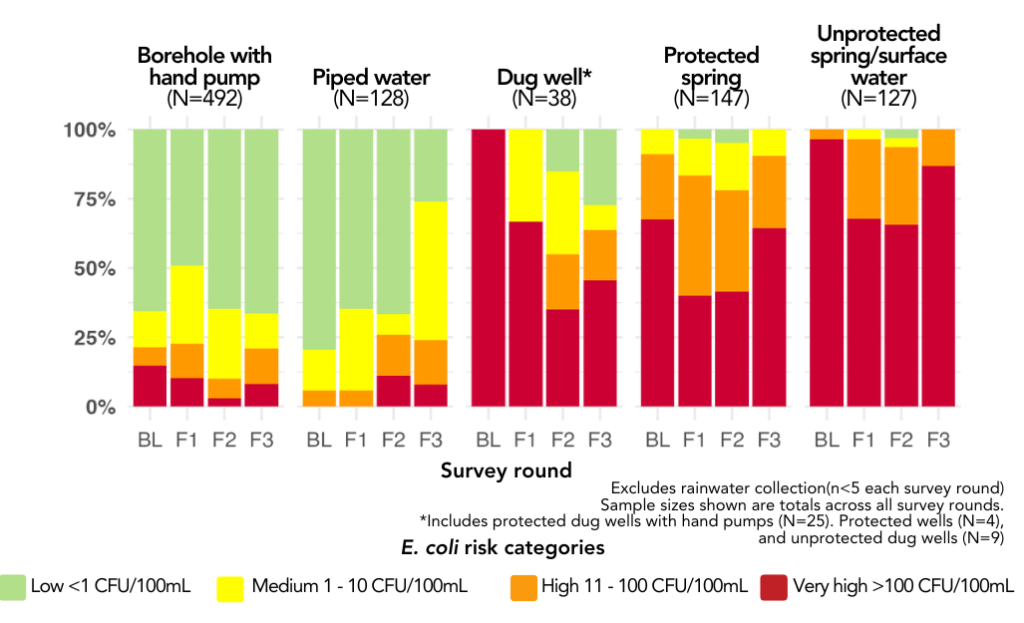
E. coli risk levels from water point samples collected at BL (N=223), F1 (N=184), F2 (N=250), and F3 (N=269) survey rounds.
Households
Overall, 12% of the 231 household drinking water samples were free from E. coli, and one-third (32%) were in the highest risk category (>100 CFU/100 mL E. coli). Most households (92%) provided drinking water samples from improved water points, including piped systems, boreholes with hand pumps, and protected springs. Samples from improved sources were marginally safer than samples from unimproved sources such as surface water and unprotected springs (14% free from E. coli compared to 0%).
Water collected directly from water points was safer than stored household drinking water. Across all survey rounds, household stored samples had significantly worse microbial water quality than samples collected directly from the households’ reported water points (9% of household samples were free from E. coli versus 46% of samples taken directly from the same water sources). This deterioration was particularly striking for piped water and boreholes with hand pumps. Very few (3%) stored piped water samples had any free chlorine residual, and few households (6%) stored water safely in a covered container with a narrow opening, likely resulting in contamination during transportation and storage.
Institutions
We surveyed 48 schools and 11 healthcare facilities and tested E. coli from their primary and secondary drinking water points when water was available. All schools and healthcare facilities used improved water points, and most (85%) had basic water service (i.e., an improved water point on premises with water available). Most primary water points (79%) were free from E. coli, slightly better than the previous two survey rounds when only two-thirds of water points were free from E. coli.
Summary
- Water samples from improved sources had lower microbial contamination than those from unimproved sources.
- Although several piped systems had detectable free chlorine residual, chlorine levels were low.
- While most households used improved drinking water sources, E. coli was present in many stored water samples.
This work (WaterTRACS) is supported by funding from the Conrad N. Hilton Foundation.