March 2024
What are the Pathways to Achieving Inclusive City-Wide Water and Sanitation Services?
Can utilities, regulators, and municipalities spearhead improvements in city-wide water and sanitation services?
Rapid urbanization in low- and middle-income countries has put pressure on water and sanitation providers, resulting in uneven progress on access to services, especially among the poorest and most vulnerable people. This study, produced by URBAN WASH, reviewed the policies, regulations, and institutional arrangements that have driven progress across 11 cities with outstanding improvements in inclusive service provision.
It identified three pathways to progress defined by the type of actor that spearheaded improvement – utilities, regulators, or municipalities demonstrating that entry points for service strengthening should be adapted to the context. This study revealed 12 cross-cutting characteristics that enabled inclusive citywide service provision, such as clear indicators and incentives, integrating small-scale providers, customer engagement, and specific pro-poor approaches. The findings of this study provide a foundation on which urban decision-makers can encourage locally appropriate types of progress.
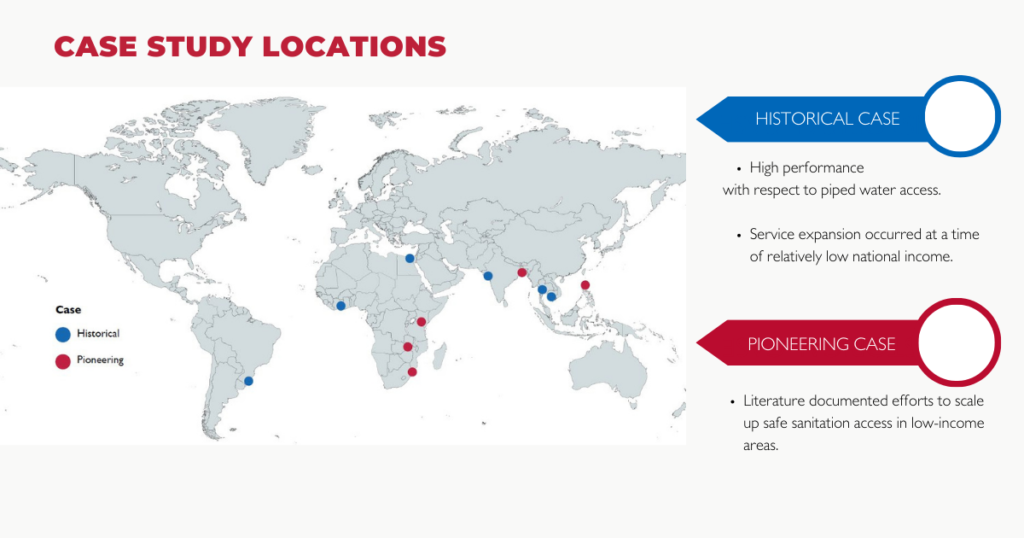
Following a broad literature review, this study selected and examined 11 cities demonstrating outstanding progress toward inclusive water and sanitation services. These cases, all located in low-middle-income countries during periods of progress, outperformed other cities with similar economic circumstances and captured a wide range of demographic, economic, political, and environmental contexts.
We included:
- Six historical cases of inclusive water service provision: Abidjan (Cote d’Ivoire), Ahmedabad (India), Bangkok (Thailand), Cairo (Egypt), Phnom Penh (Cambodia), and Porto Alegre (Brazil).
- Five pioneering cases of citywide sanitation coverage: Faridpur (Bangladesh), Lusaka (Zambia), Maputo (Mozambique), Nairobi (Kenya), and San Fernando (Philippines).
In 2050, as shown above, very few countries’ rural populations will exceed the urban population, including several across sub-Saharan Africa, Asia, Pacific Island States, and Guyana in Latin America.
Research Questions
This study investigated two research questions:
- What policies, regulations, and institutional arrangements have historically been instrumental in driving inclusive improvements in piped water access and citywide sanitation?
- To what extent do the characteristics identified from historical examples of success play into current innovative efforts toward improving urban water and sanitation services?
Findings
Different actors can initiate progress and provide momentum for improvements. Across the 11 cities, there were three distinct pathways to progress, with initial improvements driven by utilities, regulators, or municipalities. Supporting progress requires identifying a dominant pathway and area for improvement.
Common characteristics contributed to inclusive water and sanitation services across contexts. Regardless of the actors driving progress, 12 common characteristics, such as clear performance indicators and incentives, community participation, and formalization of small-scale providers, contributed to the progress.
Progress on inclusive sanitation services does not always align with lessons from the water sector. The complexity and diversity of actors involved in urban sanitation necessitate dedicated institutional and regulatory frameworks and experimentation to identify new technologies and financing options.
This report is made possible by the support of the American people through the United States Agency for International Development (USAID).