December 2023
How can India Effectively Plan for Rural Drinking Water in the Era of the Jal Jeevan Mission?
The Jal Jeevan Mission
The Jal Jeevan Mission in India is transforming rural domestic water supply, water use, and water resources management in complex and diverse ways. The program is committed to providing household tap connections to all rural households by 2024. India’s rural drinking water sector is undergoing rapid changes driven by the $45 billion nationwide program.
Although water is a topic that falls under the jurisdiction of individual states in India’s Constitution, the central government can and does encourage countrywide initiatives through financial assistance and planning recommendations. These programs aim to implement rural water initiatives across the nation while still allowing some degree of customization by individual states. The Government of India reports that more than half of rural households have received functional in-house tap connections (Jal Jeevan Mission Dashboard 2023).
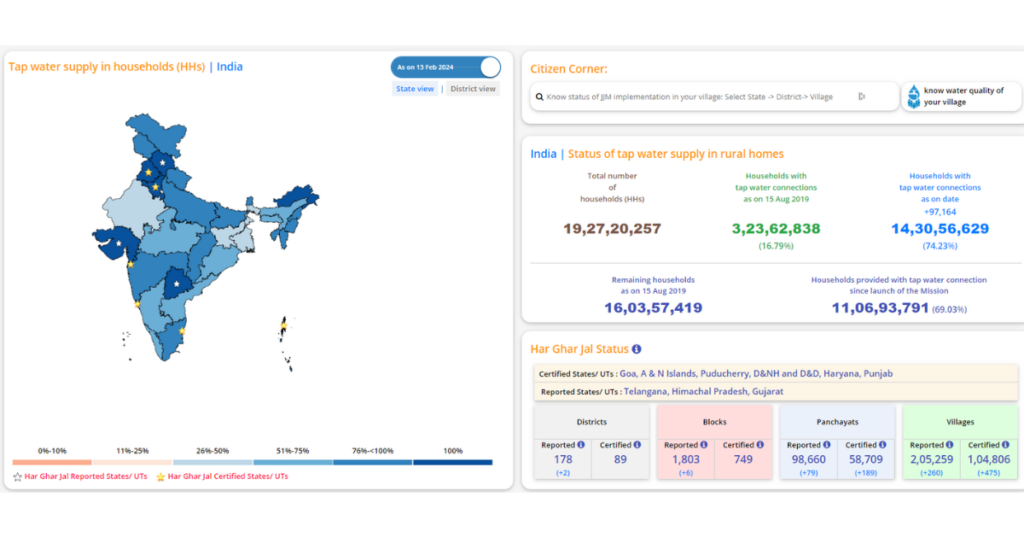
A snippet of the Jal Jeevan Mission’s official dashboard showcasing the status of tap water supply in rural homes in India.
The Jal Javeen program provides the backdrop for the REAL-Water study of rural domestic water supply and its relationship with water resources management at the national, state, and local levels. The physical infrastructure for rural drinking water supply under the Jal Jeevan Mission is being implemented through single-village or multi-village schemes, each of which has different components and implications:
- Single-village schemes tend to be groundwater-based and operated by a Gram Panchayat (a basic governing institution in Indian villages). Villages may have more than one water source and more than one water supply scheme. Ensuring water source sustainability entails watershed protection measures, managed aquifer recharge, upstream afforestation, and pumping practices. There is limited evidence to determine whether these efforts result in the source being sustained.
- Multi-village schemes tend to be surface water-based and run by state-level professional agencies. Coordination across villages to ensure equitable water quantity allocation for each is critical, alongside effective operations and maintenance. Water source sustainability entails basin-scale integrated water resources management across surface and groundwater resources and water use sectors.
Key Takeaways
- Rural drinking water progress is hampered by a lack of local planning and rushed efforts to achieve the 2024 deadline.
- Despite the national drinking water program, states have significant differences in the institutional context of rural drinking water planning.
- Local institutional gaps in single- and multi-village schemes work against ensuring source sustainability.
- The Jal Jeevan Mission is based on a community-plus management model.
This report is made possible by the support of the American people through the United States Agency for International Development (USAID). The contents of this brief are the sole responsibility of The Aquaya Institute and REAL-Water consortium members. They do not necessarily reflect the views of USAID or the United States Government.