December 2022
Tanzania Institutional Framework for Water Supply
COUNTRY OVERVIEW
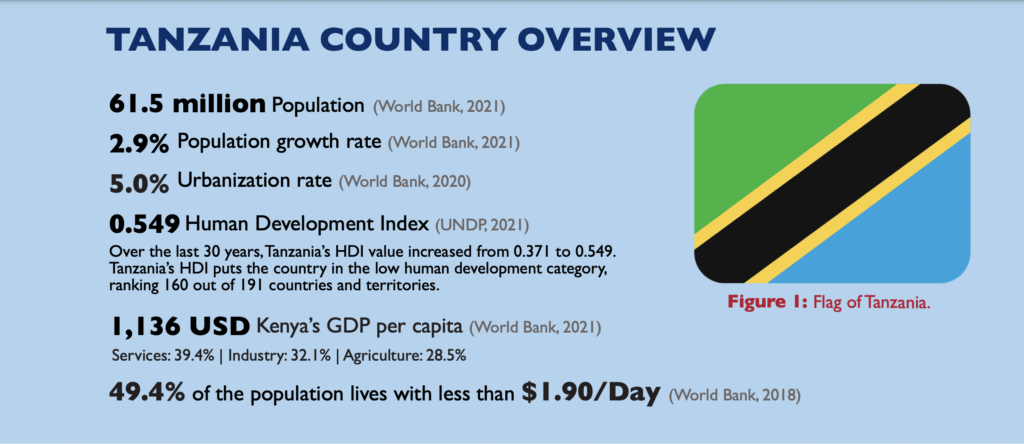
The United Republic of Tanzania is located east of Africa’s Great Lakes. Tanzania’s sustained growth from a low-income to a lower-middle-income country mirrors its positive progress toward access to safe water and sanitation for all. Access to basic water sources has increased from 28% in 2000 to 61% in 2020. 38% of Tanzanians rely on piped water, while 34% use non-piped improved sources. In terms of drinking water service levels, a total of 13% of the population relies on surface water, 15% on unimproved sources, 11% on limited sources, and 61% on basic sources.
In urban areas, piped sources are most common (60%), with three in ten households (31%) having piped water into their dwelling or yard, a further two in ten (21%) getting their drinking water from a neighbor’s piped supply, and one in ten (9%) from a public tap. In rural areas, 7% of households have piped water into their dwelling or yard, with a further 4% getting their drinking water from a neighbor’s piped supply and 17% from a public tap (totaling 28%). Meanwhile, progress has also been made in safely managed sanitation services, increasing coverage from 5% in 2015 to 26% in 2020.
Despite Tanzania’s abundant water resources, its varied climate and geological formations contribute to seasonal, interannual, and geographical variations in water quality and availability. According to the Falkenmark Water Stress Index (Falkenmark 1989), the country has a moderate stress level since its yearly renewable water is about 1,680 m3 per person, and key economic sectors abstract only 13% of the total water resources.
Institutional Framework for Water Supply