March 2026
Benefits of piped water connections in underserved communities: A matched household comparison in Accra, Ghana
Goddard FGB, Qureshi H, Poulin C, Boachie F, Jordan E, Otoo M, et al. (2026) Benefits of piped water connections in underserved communities: A matched household comparison in Accra, Ghana. PLOS Water 5(3): e0000519. https://doi.org/10.1371/journal.pwat.0000519
Abstract
A quarter of the world’s population lacks access to safely managed water. In Accra, Ghana, where less than half the population has a piped connection on premises, improving access is a government priority. This study used a quasi-experimental design to explore the benefits of on-premise piped connections among direct (connected) and indirect (neighbors of connected households) users.

Fig 1. Study areas. Surveyed project communities included Ngleshie Amanfrom, Tetegu, Ofankor, Krokrobite Langma, Tsui Bleo, Obeyeyie/Achiaman/Ayikai Doblo/Doblo Gonno/Ashaladza, Gbestile, Teshie Old Town, Okataban-man, Shukura, Amrahia, Royal City/Agbeshie Laryea, Ashiyie-Fulani, Nungua-Zongo, and My Brother. Surveyed non-project communities included Kubekrom 1, Kubekrom 2, Oshiyie, Rosa Rosa, and Dodowa Zongo.

Among 2,521 households surveyed, 720 (29%) had access to piped water on premises. Piped water was primarily available intermittently, with only 17% of connected households reporting that piped water was available every day. Most connected and unconnected households (90%) reported using packaged water for drinking.
Households with a piped connection on premises experienced greater convenience and time savings: they were less likely to report cost barriers (OR 0.26; 95% CI: 0.14 to 0.48), less reliant on supplementary water sources (OR 0.45; 95% CI: 0.34 to 0.59), and collectors saved an hour fetching water per week (95% CI: 38–84 minutes). However, these households were less likely to have their domestic water source available every day (OR 0.13; 95% CI: 0.09 to 0.18) and equally likely to store water (OR 1.04; 95% CI: 0.69 to 1.56). Indirect users were less likely to be dissatisfied with their primary domestic water source (OR 0.45; 95% CI: 0.31 to 0.67), but otherwise, benefits were less pronounced. We found no differences in perceived water security or income-generating activities associated with piped connections.
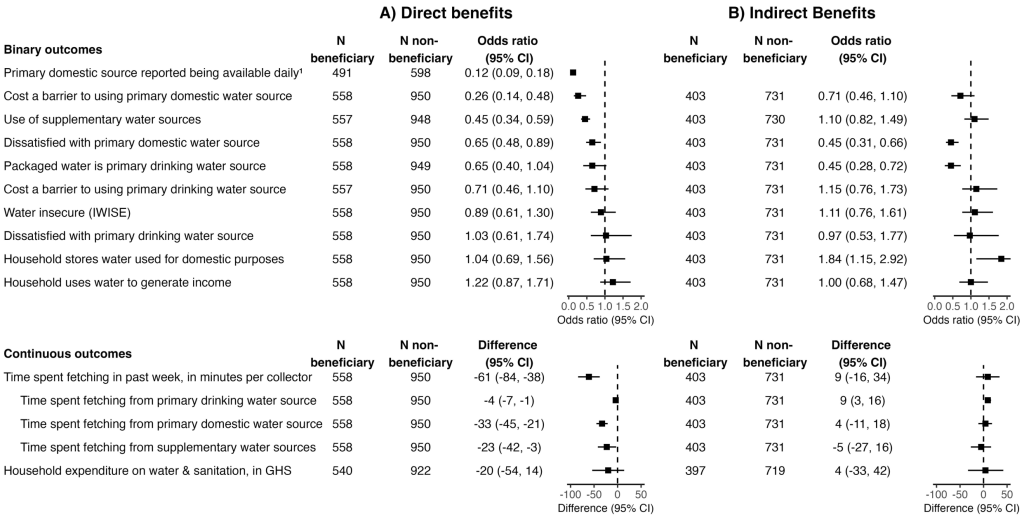
Fig 2. Benefits. A) Direct benefits: comparing connected and unconnected households; B) Indirect benefits: comparing households relying on their neighbor’s connection (indirect users) and households that do not use piped connections (non-users). Data not collected from households that used their neighbor’s connection (i.e., indirect users). In the direct benefits column, the odds ratio for this outcome thus compares connected households to households that did not use piped connections (i.e., non-users). For indirect benefits, this outcome was not estimable.
These findings provide nuanced insights into the benefits of increasing piped water access in Accra’s underserved communities. In this setting, the benefits of piped water services will not fully materialize until all households have access to a connection on premises and issues of intermittent supply are addressed.
Ghana Water Limited deserves recognition for both its efforts to expand private connections in Accra’s underserved communities and its openness to independent evaluation.